

For the space you have, your doing really well! The smaller the space, I read somewhere, the more neat you have to be. I will add to that, you also have to be more selective about the equipment and small purchases you add since you truly need a place for everything and everything in its place.
-
I think in straight lines, but dream in curves
-
That would be awesome Dave. It probably won't be today, but I can probably do it tomorrow.
Conferences today.Comment
-
I should probably mention this, but you are probably already aware, the saw needs to slide to the left in order to be able to use the SMT.Please like and subscribe to my YouTube channel. Please check out and subscribe to my Workshop Blog.Comment
-
Okay now I have grabbed and looked at your Sketchup file... I sort of get the idea... A couple of thoughts, take them for what you paid for them okay?
#1. Your floor measures 12' x 12'. I am guessing you aren't taking wall thickness into account here. At a minimum you are going to lose 8" each direction (4" per wall), considering how small the space is, you really ought to make that adjustment.
#2. You have some BIG things in a small space. A dedicated router table, a floor model jointer, 14" band saw etc... Now I am not saying it can't all fit in, but you do realize it is gonna get TIGHT in there. Your idea of porting through the wall isn't a bad one, just realize that any heat / A/C you have in there is going to get sucked out of the building, that is why I suggested a lean to / bump out on the building.. Keep it in the same air space. I hate to link to other forums, but there is a user on Lumberjocks that has a really nice shed / shop with a bump out that I think you should see... This guy is in a 12x16, and he says he is trying to put a 10lb tenon in a 5lb mortise...
#3. Do you have a link to the current Sketchup. I would like to view it in 3D so I can orbit around and see what is placed where... I can tweak some and see if you like the changes...Please like and subscribe to my YouTube channel. Please check out and subscribe to my Workshop Blog.Comment
-
Is it the one I uploaded a few weeks ago? If so that was 12x12 but someone in this thread pointed out that error to me and I made the proper adjustments to this model. I'm approx 11'6" in both directions, give an inch or so to take into account I haven't swapped the thin walls with stringers for the thicker one-shot OSB. So I'm comfortable with using 136'^2 as the working area.
I am trying to jam a bunch of stuff in there. I would get rid of the router table if I could incorporate it into something else I like, I just like the aesthetics. I would like to have the DC elsewhere, it would be my first choice. The problem I think I'm going to run into with code is that I'm at the maximum footage allowed with how close I am to the property line. I can't move it directly away from the line because I have a couple of huge hickory trees right there. In fact, the only other suitable place on my property to put a larger building isn't graded for it at all. I would incur a very large expense just getting the landscape right before I even got into the cost of a new building.
The question I'll have to have answered by the county is if adding a lean-to, with a separate entrance would be considered adding to the covered square footage. If it's not, then I'm golden. I'd build a two-level addition to the back where I could have the DC and AC situated above a space to put a riding lawn mower. It would be the ultimate solution, and not a very expensive one all things considered. Beyond that, I could see if I could build a freestanding shack for the DC and run a permanent or temporary duct between the buildings to skirt code. Doable, but more expensive, uglier and increased hassle. I'm really putting the DC in the footprint to see if it could be done as an emergency measure. It's out of the next iteration. I don't have electricity at all, so heat or cooling loss isn't a factor.
I haven't been able to load the planned layout or my current layout into the database because it keeps being rejected for being too big. I'm not sure how to get around that.Comment
-
OK, I really think I have a winner here. I saw it in my head and it felt like a revelation. I think it would be feasible to hang up a wall DC in a few places if I had to go that route.


The saw could stand up and slide over to the wall next to the bandsaw, pretty much where it says 1-7/8". The saw and the router table could swap positions up against the side wall if need be, just have to take off the SMT. Which, after I add miter slots, I may not use all that often.
I think the inlet for the DC would come in between the jointer and the cabinet, just below the cabinet surface.Last edited by Cochese; 10-24-2011, 06:01 PM.Comment
-
Given that you have a 21829, that setup is a real winner... I am wondering though, with the big limits on space, why not take advantage of the router table accessory for the 21829 instead of a stand alone table?
If push comes to shove on the DC, you could always stow it indoors, and wheel it out the door if you have to...Please like and subscribe to my YouTube channel. Please check out and subscribe to my Workshop Blog.Comment
-
I built the table before I had the saw, and honestly I prefer it. If I find I never take my saw outside anymore in this setup, I may stow the stand and combine the two into a wide table.
Right now I'm working on that dust separator/planer stand and hoping I can cut a 4.5"d circle without having to go buy an expensive hole saw.Comment
-
On the hole saw question... Mind you I have lamented doing this myself and posted how much I HATE their hole saws because they are complete and utter junk, but if all you need to do is cut one hole, go get yourself the large hole saw set from Harbor Freight, cut your hole, clean up the edges, and chuck the thing in the trash... I don't see them on the web site any more, but they used to be around $5.00 for the large size, which had sizes between 2" and 5"... I used mine to score the lines to jig saw out the 5" holes in my hardi panel for my A/C ducts to the shop... Perfect for one time use, an utter waste of money for anything more...
DOH!!!! Idea just hit me looking at your pics again... Swap places between the drill press and the router table, that way you aren't pressed up against the router table!Please like and subscribe to my YouTube channel. Please check out and subscribe to my Workshop Blog.Comment
-
Not a bad idea about swapping the two.
Unfortunately I checked my HF last night, and the largest they carried at this one was 2.5" in a set.
What I'm going to try to do is trace an accurate hole (picked up a $2 grinding disc for that), use a drill to start a pilot hole and use the jig to complete the cut. I'll clean it up on the sander and use my router and a pattern bit to do the rest of them (three in total). If they aren't perfectly round, oh well.Comment
-
Please like and subscribe to my YouTube channel. Please check out and subscribe to my Workshop Blog.Comment
-
Ask me again some time, I just might.
Fortunately for me, Rockler included a bit of wiggle room in their fittings by incorporating a wide flange. A forstner bit, my router and my jigsaw appears to have gotten the job done.
I hope this works as well as I hope it does, my bucket separator already is in permanent implosion mode with my shop vac. This has 4" ports and two drawers, for collection.Comment
-
I thought I was done planning, but I guess it really never ends. I neglected to add a spot for my Kreg jig, figuring I would find a spot later. But I think I may want a spot that would serve that purpose, plus a joiner jig, mortiser spot, frame assembly spot (clamping) and possibly a downdraft spot. It's a lot of things, but if there's a stand or an area that would accommodate light and exchangeable surfaces, I'd like to try.
I'm thinking of two ideas. One would be to use something similar to the temporary stand I made for my OSS, something about 2' square and 3' tall.
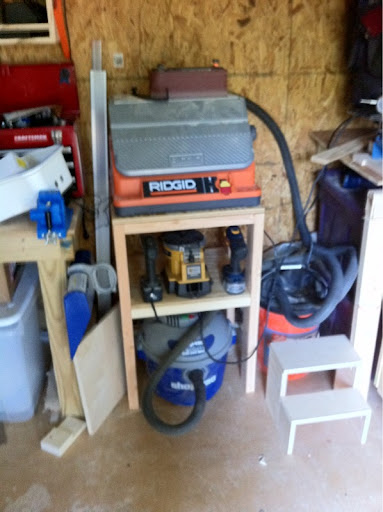
The modules should be light enough where they could hang on a wall or the unit itself, possibly. Concerned about stability.
The other option I was thinking of was doing something I had considered a long time ago - having my entire back wall be a cabinet. Doing this would be a bit more of an undertaking than I was planning, but this would solve quite a few problems that I've been wanting to fix. The drawers aren't complete, and the interior of the cabinet is screwed up because I originally was going to use hardwood. I have very little room to the right of my miter saw.
I'll be working on the Sketchup of the possible full wall this week to see if it would work with space.Comment
-
Wondering what everyone thought of anti-fatigue mats as a floor covering, and how well they do (in general) with rolling tools over.
I have a spot somewhat in the middle of my floor, at least where tools will roll over, that is damaged and is not even with the rest of the floor. Considering using this to cover most of the floor and even out the dip a bit.
Also, wondering how well they actually work to prevent fatigue.
Also, I've edited the title of the thread, can a mod change it to reflect the same in the forum table? Thanks.Comment
-
I have anti-fatigue mats in the main standing areas of my shop. My big miter saw/storage cabinet rolls accross the edge of one mat on a regular basis. It's a PITA. Larger casters (I'm using 3" ones) and less weight might be a bit easier.
OTOH, the anti-fatigue feature really works. Perhaps more importantly, I've found that my sharp tools are damaged less when they're inevitably dropped - some sort of Muphy's Law corollary, "The probability of the chisel falling point down, is directly proportional to the hardness of the floor."
JRJRComment


Comment