Anyone run dissimilar compressors in tandem?

Collapse
This topic is closed.
X
X
 
  • Time
  • Show
Clear All
new posts
  • dbhost
    Slow and steady
    • Apr 2008
    • 9523
    • League City, Texas
    • Ryobi BT3100

    #1

    Anyone run dissimilar compressors in tandem?

    Just wondering about this. I REALLY want to set up the overhead hose reel to keep my air hoses controlled, and out of the way. However I know I am just barely under the required CFM for my impact wrench with the 29 gallon compressor, and I am concerned that the reel will render it useless. FYI the Earthquake 1/2 in impact flows at 6CFM @ 90 PSI, the HF 29 gallon 250 PSI compressor flows at 5.9 CFM @ 90 PSI. It works for intermittent use, but needs some added oomph. Espeically since I am considering adding an air sander to my arsenal for things like wet sanding the car for paint prep.

    I have the HF 8 gallon 2HP 125 PSI compressor sitting under my dust collector, which can be put in tandem with the 29 gallon I think... That compressor develops 4.5CFM @ 90 PSI...

    I am thinking, perhaps incorrectly, so help me out here guys... that I need to regulate the big compressor to 125 PSI, keep the 8 gallon wide open, and then connect the two to the whip tee.

    At the tee, I can add a separator / filter with regulator (already have one, and regulate it all down to 90PSI or whatever the need may be... (None of my pnuematic tools operate over 90PSI, and spraying is even lower, MUCH lower...

    So the specs for the compressors are.

    29 gallon compressor.
    CFM @ 90PSI = 5.9
    CFM @ 40PSI = 7.3

    8 gallon
    CFM @ 90PSI = 4.5
    CFM @ 40PSI = 5.5

    Theoretical combined totals. It is understood that the total CFM numbers should be somewhat lower due to losses in the plumbing.
    Tank storage. 37 gallons.
    CFM @ 90PSI = 10.4
    CFM @ 40PSI = 12.8

    Mind you, I am trying to drive the following tools...

    1/2" impact wrench. 6 CFM.
    3/8" Air ratchet. 6 CFM.
    Air Hammer 3 CFM
    HF HVLP spray guns. 6 CFM
    HF Siphon spray gun 1.5 CFM
    Husky Siphon spray gun 9 CFM
    Dual Action Sander 4 CFM.
    HF Nailer / Stapler .5 CFM
    HF Framing Nailer 3 CFM
    HF Finish Nailer 1.5 CFM
    HF Pin Nailer .2 CFM

    So the big questions are...
    #1. Is this safely doable the way I describe it?
    #2. Would the end result be what I expect?
    Last edited by dbhost; 03-28-2014, 08:58 PM.
    Please like and subscribe to my YouTube channel. Please check out and subscribe to my Workshop Blog.
  • JSUPreston
    Veteran Member
    • Dec 2005
    • 1189
    • Montgomery, AL.
    • Delta 36-979 w/Biesemyere fence kit making it a 36-982. Previous saw was BT3100-1.

    #2
    Ironically, I was about to PM you to ask a question about what size compressor you would recommend for auto tools. Looks like you've answered me already.
    "It's a dog eat dog world out there, and I'm wearing Milk-Bone underwear."- Norm (from Cheers)

    Eat beef-because the west wasn't won on salad.

    Comment

    • dbhost
      Slow and steady
      • Apr 2008
      • 9523
      • League City, Texas
      • Ryobi BT3100

      #3
      It really depends on the automotive tools...

      The HF Earthquake impact, and the HF air ratchet both pull 6 CFM.

      The Husky 1/2" heavy duty impact pulls 4 CFM as does their air ratchet.

      Not sure why such a big flow difference, but it is there...

      The Husky spray gun however uses 9 CFM. Ouch...

      When I worked for the "Big shop" which was a large tire and service center in Houston off of Kirby, we had a bank of compressors, 4 of them, similar to the Ingersoll Rand 80 gallon 5HP compressors. Mind you, that served a 12 bay tire shop that was busy running tire inflators, air wrenches, pnuematic controls for vehicle hoists etc... all day long.

      If I had nothing but money, and space. I would replace both HF compressors with a Maxair C5160V1-MAP 60-Gallon 170 PSI Max Electric Stationary Compressor. HOWEVER, space, and funds being what they are, at least for now, I have to look into lower budget alternatives.

      When I bought the 29 gallon compressor, I wasn't wedded to the idea of another Central Pnuematic compressor. But it had the best specs out of any in the 25-30 gallon class that I could find. The 5.9 CFM @ 90 PSI was a real selling point, but just shy of what the HF gun is rated to...

      I would say that unless you are planning on using a large 3+ HP 60 gallon or so air compressor, I would highly recommend the 29 gallon 150 PSI Central Pnuematic, not the 125 PSI model. And then shop your automotive / spray tools to fit the compressor... There is a LOT out there that will work at 5.9 CFM @ 90 PSI!
      Please like and subscribe to my YouTube channel. Please check out and subscribe to my Workshop Blog.

      Comment

      • capncarl
        Veteran Member
        • Jan 2007
        • 3756
        • Leesburg Georgia USA
        • SawStop CTS

        #4
        In my previous job we had a number of compressors scattered all over the plant supplying one header. No problems. Most residental compressors have check valves to keep the compressed air from leaking back through the compressor. It may not be a bad idea to install a check valve at each compressor tie in to the header just in case.
        capncarl.

        Comment

        • LCHIEN
          Super Moderator
          • Dec 2002
          • 22012
          • Katy, TX, USA.
          • BT3000 vintage 1999

          #5
          search google for parallel air compressor or tandem air compressor, quite a few hits...
          Loring in Katy, TX USA
          If your only tool is a hammer, you tend to treat all problems as if they were nails.
          BT3 FAQ - https://www.sawdustzone.org/forum/di...sked-questions

          Comment

          • woodturner
            Veteran Member
            • Jun 2008
            • 2049
            • Western Pennsylvania
            • General, Sears 21829, BT3100

            #6
            Originally posted by dbhost
            #2. Would the end result be what I expect?
            I've talked at length with one of the ME profs here about combining the outputs of two compressors. The biggest issue is that the regulators are not very resistant to back pressure, so it doesn't work well to just tie together the two outputs.

            Ideally, you want to tie all the tanks together before the regulator, and use one regulator for the system.

            Another issue is that if the pressure switches on the compressors are not all set the same (which is, for practical purposes, impossible) the compressor that comes on first will do all the work and the others won't run much if at all. As a result, the cfm available ends up in the range of 10% more, not double as you would hope for two compressors.

            One way to tie outputs together is to add check valves, but that doesn't solve the "weakest link" problem. In addition, check valves add to the system cost, perhaps why the compressors do not already have them.

            My conclusion is there are some ways that people do tie together air compressors but none of them really work well, and there is not an economical way to do it that does work well. After futzing around with two, I eventually just bought a bigger compressor.

            One method that does work, in some cases, is to run different tools off different compressors. For example, when using the sandblaster, I used one compressor to pressurize the tank and the other to propel the media. The compressors were separate but this allowed me to use both to good effect.

            If you are doing a job that requires two air tools, running each one off its own compressor works well, too.
            --------------------------------------------------
            Electrical Engineer by day, Woodworker by night

            Comment

            • dbhost
              Slow and steady
              • Apr 2008
              • 9523
              • League City, Texas
              • Ryobi BT3100

              #7
              Double checked with some of my old college textbooks, and an aerospace engineer neighbor of mine (I live just south of Houston remember?), and from what I can see, the physics behind running them in parallel, insuring I use a check valve AFTER each compressor's regulator, and the CFM should be additive... Minus losses in efficiency brought on by the tee, couplings, lengths of hose etc...

              Of course fluid dynamics and aerodynamics required heavy use of calculus which is why I never continued down the path to my engineering degree.

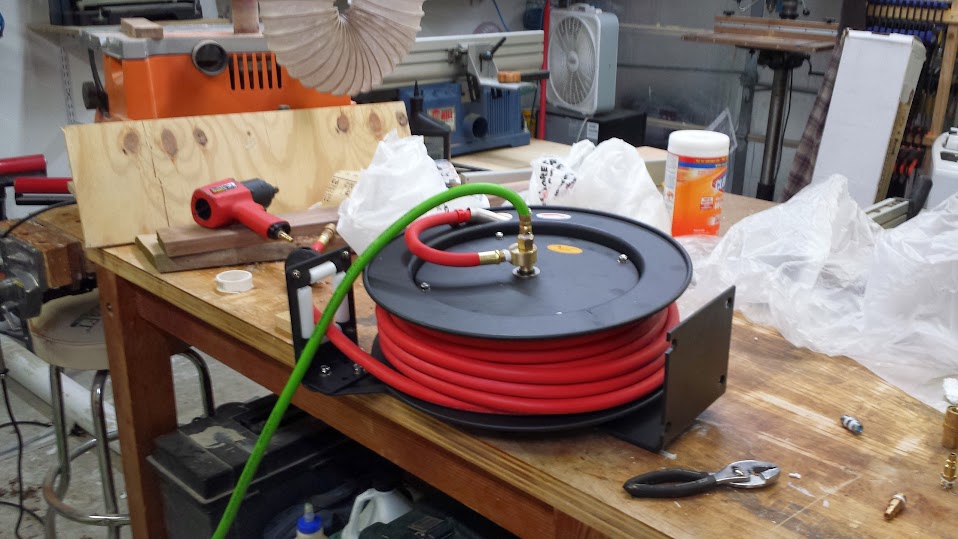
              I stopped by Harbor Freight on the way home tonight, and picked up the reel, a 3' 3/8" rubber hose, an 8' 3/8" rubber hose, and a 25' rubber / PVC blend hose. The rubber seems pretty decent. But I STRONGLY suspect the rubber / PVC blend hose is going back. I can feel the jacket and inner liner slip, and it kinks like crazy.


              I did grab the reel and the 3/8 x 1/4 brass bushing. Oddly enough unlike Loring and MANY other folks experiences, mine had a 1/4" NPT fitting, no need for the bushing. So refund time when I return that blend hose too!

              I made my connections, and they regulator on the 8 gallon does NOT like this setup. So I went ahead and ordered a pair of in line check valves from Zoro Tools. They had them for about 1/3 less than Grainger with FAR less expensive shipping... Until such time as the check valves come in, I will leave the ball valve in the off position on the 8 gallon compressor. Actually ball valve off, compressor off, and tank drained.


              I made my incoming hose connections per most compressed air system schmeatics where the incoming lines come in from above, and there is a drain drop / valve at the bottom... No valve here, but that can change easily, I have spares...

              I noticed the reel has 2 slotted holes, and 2 open holes for mounting. While I get Loring's method, the arrangement looks like I can put my mount board up first, with a pair of bolts in for the slotted holes, and pre drilled holes lines up for the solid holes, slide the slotted hole end in and let that carry the weight, then I should be able to, with one hand, push the reel the rest of the way up while the other hand gets the first of the solid hole bolts started, then resting on the three bolts, the last can be started, and finally, all 4 run home.

              I pulled a little trick on my Earthquake impact that I remember from years past, and oiled the living snot out of it. Literally held the trigger open, and then poured probably a full ounce of air tool oil down the nipple. Then I let it soak overnight. Well tonight I tested it at least free spinning. No bolts I am ready to impact off quite yet...

              I plugged it in, pulled the trigger and was quickly reminded about all that air tool oil in the tool. Cleaned the mess up, then ran it some more, after about 10 seconds of so so spinning, no real power to speak of, it spit, something came out of the exhaust vent that looked like plastic, like a piece of plastic protective wrapping, and then the thing nearly torqued itself out of my hand...

              So my issue with the impact may not have been that .1 CFM shortage...

              Of course I will keep everyone posted on my experience with this setup... And FYI, if anyone can tell me a reasonable way to test for actual CFM @ the hose end I would LOVE to actually test this...

              If this works as expected in the theory, for most all one man shops with all but the most extreme tools, a pair of those 8 gallon 2HP compressors in parallel will drive pretty much anything anyone would want to throw at it...
              Please like and subscribe to my YouTube channel. Please check out and subscribe to my Workshop Blog.

              Comment

              • gerti
                Veteran Member
                • Dec 2003
                • 2233
                • Minnetonka, MN, USA.
                • BT3100 "Frankensaw"

                #8
                Btw 5.9 + 4.5 = 10.4

                Comment

                • dbhost
                  Slow and steady
                  • Apr 2008
                  • 9523
                  • League City, Texas
                  • Ryobi BT3100

                  #9
                  Originally posted by gerti
                  Btw 5.9 + 4.5 = 10.4
                  Did I mention there is a good reason I am not an engineer?

                  Sorry, I have been working a huge project at work pulling a LOT of 16+ hour days, including a couple 20 hour shifts... My brain is seriously foggy...
                  Please like and subscribe to my YouTube channel. Please check out and subscribe to my Workshop Blog.

                  Comment

                  • LCHIEN
                    Super Moderator
                    • Dec 2002
                    • 22012
                    • Katy, TX, USA.
                    • BT3000 vintage 1999

                    #10
                    Mine has the two slotted, two fixed holes in the base, too. But I still felt I could not hoist in into place, push the slots against two bolts and the while still supporting the free end start a third bolt into one of the fixed holes AND tighten it (with the third hand?) since there's not a straight path over (ok, from below) the hole allowing you to use the socket to hold the bolt and turn it at the same time.


                    Funny about that 3/8", or 1/4" fitting thing that they would build them differently. I guess that's central Pneumatic quality control. I don't see an ISO 9000 sticker anywhere on the box!

                    There are a lot of problems running two compressors together. In the electronics parallel word, that's like hooking outputs of two power supplies together which is almost never done.
                    Last edited by LCHIEN; 03-28-2014, 10:34 PM.
                    Loring in Katy, TX USA
                    If your only tool is a hammer, you tend to treat all problems as if they were nails.
                    BT3 FAQ - https://www.sawdustzone.org/forum/di...sked-questions

                    Comment

                    • dbhost
                      Slow and steady
                      • Apr 2008
                      • 9523
                      • League City, Texas
                      • Ryobi BT3100

                      #11
                      Originally posted by LCHIEN
                      There are a lot of problems running two compressors together. In the electronics parallel word, that's like hooking outputs of two power supplies together which is almost never done.
                      I hope I am not giving anyone the idea I am permanently wedded to the concept of running the compressors in parallel. My plan was more along the lines of try it, see how it worked, and if it pans out well, keep it, if not, not a huge investment for an experiment.

                      Yeah, funny thing about iso certification, it is sort of like that Lean Six Sigma thing... You need to have processes documented in place. It doesn't really matter if they are lousy processes that result in a horrid product, and miserable customer service, but you have to have processes...
                      Please like and subscribe to my YouTube channel. Please check out and subscribe to my Workshop Blog.

                      Comment

                      • LCHIEN
                        Super Moderator
                        • Dec 2002
                        • 22012
                        • Katy, TX, USA.
                        • BT3000 vintage 1999

                        #12
                        Originally posted by dbhost
                        I hope I am not giving anyone the idea I am permanently wedded to the concept of running the compressors in parallel. My plan was more along the lines of try it, see how it worked, and if it pans out well, keep it, if not, not a huge investment for an experiment.

                        Yeah, funny thing about iso certification, it is sort of like that Lean Six Sigma thing... You need to have processes documented in place. It doesn't really matter if they are lousy processes that result in a horrid product, and miserable customer service, but you have to have processes...
                        yeah, that's true, if you goal is to make cheap products, then your ISO procedure can say use any old part that will fit and is available cheaply.

                        If your goal is to make quality products then one more or less key item is to make every one of them exactly alike which means no substitution of parts and if your vendor catches on he can raise prices on you!

                        A more reasonable goal is to make products exactly interchangeable which means that you can use anyone's fitting as long as it meets the basic specified criteria, i.e. brass female socket 1/4" NPT.

                        Making some with 1/4" NPT and others with 3/8" NPT makes the units non interchanegable while still similar in function. And I was not able to use the unit immediately, I had to go to another store and but an additional parts costing nearly 10% of the purchase price of the unit.

                        ultimately it will do the job but cost me unexpectedly in time and money.
                        Loring in Katy, TX USA
                        If your only tool is a hammer, you tend to treat all problems as if they were nails.
                        BT3 FAQ - https://www.sawdustzone.org/forum/di...sked-questions

                        Comment

                        • LCHIEN
                          Super Moderator
                          • Dec 2002
                          • 22012
                          • Katy, TX, USA.
                          • BT3000 vintage 1999

                          #13
                          Dave one important thing to remember is what the heck are CFMs to a compressor.
                          The first thing is, I would expect CFM ratings of a compressor are with the measuring point right at the outlet of the compressor. Using a hose of 3/8" (most cheap poly and rubber hoses ) or 1/4" (most of your home destined PU hoses) and 50 feet will surely reduce the CFM available at the end of the hose. Two hoses, like a supply hose and the 50' hose on your reel will take a bigger hit on available CFMs.

                          If you use a tool with high CFM requirement you should consider starting out with bigger diameter hoses like 1/2" and larger ID connectors like 3/8" QC and Studs. Of course that also suggests a compressor with higher output - 220Volt models, 120V usually wont do much for larger hoses.

                          Finally what the heck do the CFM numbers mean on tools? Is that the number for the compressor assuming a nominal hose, or true CFM at the tool? Do they really require that or are they fudging the numbers to be on the safe side? CFM number for stapler and nail guns are really hokey because what firing rate are they at? As most of the work for a nailer is done with the air in the housing of the gun rather than the air in the compressor tank, you'll get adequate performance if you wait for the rush of air you hear to die down.

                          For tools like grinders the air consumption is probably a function of the load and trying to maintain speed. For sprayers, that number depends a bit on the viscosity of the stuff being sprayed, but stays a constant number.

                          One thing that air tools (some, anyway) have over electrical tools and extension cords... the hose has volume and stores quite a bit of energy (Just release the hose from the compressor and hear all the air blowing out) unlike an extension cord. So not all the impulses (e.g. nailers) have their energy coming all the way from the compressor tank. More hose actually adds some volume to the system and helps tools that don't have high continuous flow.
                          Last edited by LCHIEN; 03-29-2014, 01:09 AM.
                          Loring in Katy, TX USA
                          If your only tool is a hammer, you tend to treat all problems as if they were nails.
                          BT3 FAQ - https://www.sawdustzone.org/forum/di...sked-questions

                          Comment

                          • dbhost
                            Slow and steady
                            • Apr 2008
                            • 9523
                            • League City, Texas
                            • Ryobi BT3100

                            #14
                            The big tool that has me hung is the impact wrench. If this doesn't pan out, I am just going to offload the Earthquake and pick up a Husky H4480.
                            Please like and subscribe to my YouTube channel. Please check out and subscribe to my Workshop Blog.

                            Comment

                            • woodturner
                              Veteran Member
                              • Jun 2008
                              • 2049
                              • Western Pennsylvania
                              • General, Sears 21829, BT3100

                              #15
                              Originally posted by dbhost
                              I made my connections, and they regulator on the 8 gallon does NOT like this setup. So I went ahead and ordered a pair of in line check valves from Zoro Tools.
                              Thanks for the "drive by" on the source - was not familiar with them. Which check valves are you using?

                              I'll be interested to hear how that works for you. The engineering and "right" way of doing things is fine, but often the "real world" can give acceptable results with different or easier methods. If you can get this to work well, I may try it again - one can never have too much CFM!

                              And FYI, if anyone can tell me a reasonable way to test for actual CFM @ the hose end I would LOVE to actually test this...
                              One way would be to time how long it takes to charge a known volume to a given pressure. Recall that CFM is measured at a particular pressure, so given a 10 cu ft volume for example and a 6.3 cfm @90 psi, it should take [10 cu ft/6.3 cfm] =1.58 minutes or about 95 seconds to charge that volume. This is sort of a gross approximation, but it may get you in the ballpark anyway.

                              It can also be measured with a meter, but probably not worth buying one to do this test and not sure where you could borrow one. It's probably not something the auto parts stores would have as a loaner tool.
                              --------------------------------------------------
                              Electrical Engineer by day, Woodworker by night

                              Comment

                              Working...