Does there exist a curved floor transition?

Collapse
This topic is closed.
X
X
 
  • Time
  • Show
Clear All
new posts
  • radhak
    Veteran Member
    • Apr 2006
    • 3061
    • Miramar, FL
    • Right Tilt 3HP Unisaw

    #1

    Does there exist a curved floor transition?

    My bro is planning for replacing carpet in his living/family rooms with engineered wood. The living room flows in the family room, interrupted by the dining space in front of the kitchen, which is tiled :
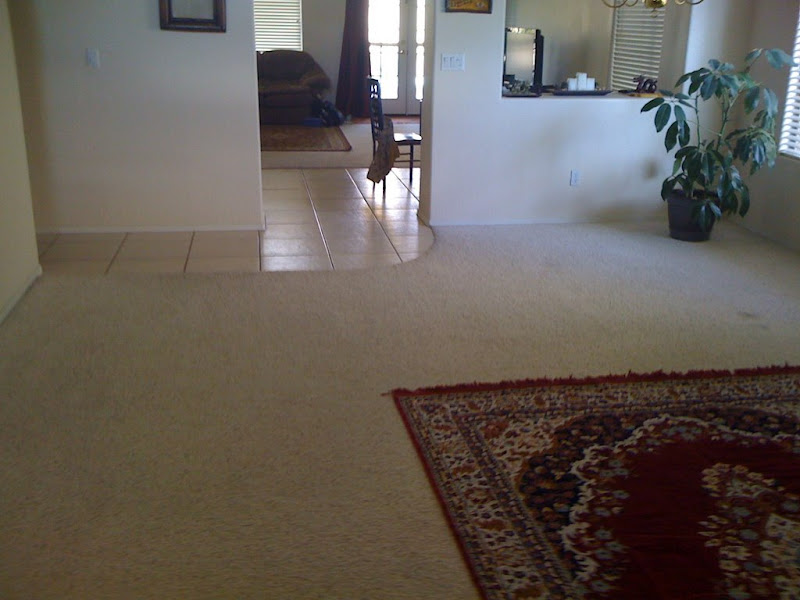


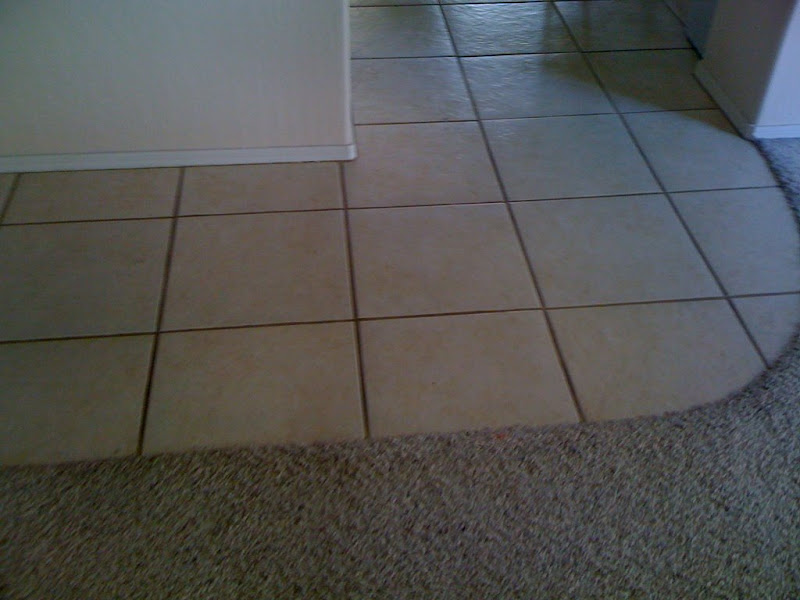
    As you can see, the problem is the part of the tile that has a curve. If he just replaces the carpet, he's left searching for a transition that would cover that curve. Does anybody have a suggestion for such a transition?

    Or, should he sacrifice part of the tile and square it up by cutting out the curved part upto the wall so he's left with just straight lines? Is this an doable or easy task?
    It is the mark of an educated mind to be able to entertain a thought without accepting it.
    - Aristotle
  • phi1l
    Senior Member
    • Oct 2009
    • 681
    • Madison, WI

    #2
    First of all let me say I have never actually done this, but I have always wanted to, but have not had the opportunity. You should be able to make up a custom bent wood transition piece.

    It will probably take a bit of experimentation. I would first try finding a piece of wood transition, and try to steam bend it to the proper curve. You will have to make a steam box from a piece of small diameter HVAC duct or even PVC pipe long enough to hold the transition piece, and a form to hold the wood in place while it cools. Since you will be bending the wood in the plane of the thicker dimension it may want to twist, so I would make provision clamp the piece in plane of the bend as well as to the curve of the mold.

    If that doesn't work, you can use the same form to make a laminated curve from 1/4 strips, then use a router to create the desired cross-section profile.

    Looks like an interesting little project.

    Comment

    • jbrain
      Forum Newbie
      • Mar 2007
      • 86
      • roseville california
      • Bt3100

      #3
      I believe on an old "Ask this Old House" episode there was mention of a company that had simulated wood transitions, made from some type of flexible material that looked surprisingly authentic.

      Comment

      • dbhost
        Slow and steady
        • Apr 2008
        • 9523
        • League City, Texas
        • Ryobi BT3100

        #4
        I was already beat to the punch on this one, but I was thinking steam bent transition as well... You are going to need to rig up a clamping jig to keep things on the straight and narrow, but I am pretty sure that not only can it be done, but I think I recall seeing something like that, just on a larger curve, done in one of the big churches here in the Houston area...
        Please like and subscribe to my YouTube channel. Please check out and subscribe to my Workshop Blog.

        Comment

        • atgcpaul
          Veteran Member
          • Aug 2003
          • 4055
          • Maryland
          • Grizzly 1023SLX

          #5
          Originally posted by jbrain
          I believe on an old "Ask this Old House" episode there was mention of a company that had simulated wood transitions, made from some type of flexible material that looked surprisingly authentic.
          I suppose it also depends on who's doing this project, you or your brother. I
          would definitely look into the simulated wood transitions. I think on the show
          they were using a flexible molding for a staircase. I don't know how durable
          they are, though, compared to wood.

          If you have an aversion to the bent route, you could also build the curve
          by joining together segments of straight wood, then cutting it to fit the
          curve you need. I don't know, maybe 2 pieces for the bend and 2 pieces for
          the straights.

          Comment

          • radhak
            Veteran Member
            • Apr 2006
            • 3061
            • Miramar, FL
            • Right Tilt 3HP Unisaw

            #6
            Originally posted by atgcpaul
            I suppose it also depends on who's doing this project, you or your brother.
            And therein lies the crux of the solution !

            I see this would be a nice opportunity to either (a) bend an existing transition or (b) create a bent blank laminate and go to work with a router or such...

            (I was thinking of cutting notches on a wood transition/molding along its length and then trying steam-bending it; the bits of wood removed with the notches could have provided relief while bending and avoid breakages).

            But since he's in a hurry and can't wait for me to be there next month (he says that's next year ), he only sees an opportunity to simplify the problem by wielding a hammer/chisel to remove some tile and square up the transition point...
            It is the mark of an educated mind to be able to entertain a thought without accepting it.
            - Aristotle

            Comment

            • cabinetman
              Gone but not Forgotten RIP
              • Jun 2006
              • 15216
              • So. Florida
              • Delta

              #7
              That radius could be cut from sections of straight wood, and glued together and then cut the curve.

              If you are particular, I wouldn't steam bend, as there is dry time and unpredictable spring back.

              Here is a method for doing bent laminations that works very well. http://www.bt3central.com/showthread...urved+moulding
              .

              Comment

              • twistsol
                SawdustZone Patron
                • Dec 2002
                • 3111
                • Cottage Grove, MN, USA.
                • Ridgid R4512, 2x ShopSmith Mark V 520, 1951 Shopsmith 10ER

                #8
                It looks like there is no transition piece there right now. In that case, you could do it the same way, tack strips cut into small pieces to follow the curve and then tuck the edge of the carpet between the strip and the tile. Since the carpet is thicker than the tile, this covers the cut edge of the tile. If you decide to square up the tile, don't use this method as the inside corners of carpet are susceptible to fraying when walked over.

                The metal transitions can be cut along the back side and then bent to almost any shape when being installed. The problem with these is that it would be on the outside edge of the tile and you would then see the cut edge of the tile.
                Chr's
                __________
                An ethical man knows the right thing to do.
                A moral man does it.

                Comment

                • cabinetman
                  Gone but not Forgotten RIP
                  • Jun 2006
                  • 15216
                  • So. Florida
                  • Delta

                  #9
                  Originally posted by twistsol
                  It looks like there is no transition piece there right now. In that case, you could do it the same way, tack strips cut into small pieces to follow the curve and then tuck the edge of the carpet between the strip and the tile. Since the carpet is thicker than the tile, this covers the cut edge of the tile. If you decide to square up the tile, don't use this method as the inside corners of carpet are susceptible to fraying when walked over.

                  The metal transitions can be cut along the back side and then bent to almost any shape when being installed. The problem with these is that it would be on the outside edge of the tile and you would then see the cut edge of the tile.
                  From the OP:My bro is planning for replacing carpet in his living/family rooms with engineered wood.
                  .

                  Comment

                  • twistsol
                    SawdustZone Patron
                    • Dec 2002
                    • 3111
                    • Cottage Grove, MN, USA.
                    • Ridgid R4512, 2x ShopSmith Mark V 520, 1951 Shopsmith 10ER

                    #10
                    Originally posted by cabinetman
                    From the OP:My bro is planning for replacing carpet in his living/family rooms with engineered wood.
                    .
                    To quote Emily Latella, Nevermind!
                    Chr's
                    __________
                    An ethical man knows the right thing to do.
                    A moral man does it.

                    Comment

                    • Mr__Bill
                      Veteran Member
                      • May 2007
                      • 2096
                      • Tacoma, WA
                      • BT3000

                      #11
                      Lay out pieces of laminate flooring to cover the curve and glue the joints together. There should be one long piece and a bunch of little ones to follow the curve. On the back side layout the curve the width you want. Prior to cutting it out use a router and make any rabbits necessary to over lap the tile and flooring. Then cut the curve with a jig saw or bandsaw. Some staining will be necessary on the cut edge. Glue it down with lots of Liquid Nails and hope for the best.

                      The other solution is to not have a transition and just butt the flooring to the tile. After it decides just where it's going to be put a bead of caulking of the desired color between the tile and flooring and call it done.

                      Bill
                      if there is a harder way to do it' I'll look for it.

                      Comment

                      • cgallery
                        Veteran Member
                        • Sep 2004
                        • 4503
                        • Milwaukee, WI
                        • BT3K

                        #12
                        I think CMan's idea of gluing-up wider pieces and then cutting the curve is a great idea.

                        I think this project has "fun" written all over it. If I could get someone else to do the engineer floor and I was only responsible for the transition (because it would likely take about as much time as laying the floor--or more, I think I'd go w/ the glue lam.

                        Comment

                        Working...