water heater leaked, what do i do now?

Collapse
This topic is closed.
X
X
 
  • Time
  • Show
Clear All
new posts
  • All Thumbs
    Established Member
    • Oct 2009
    • 322
    • Penn Hills, PA
    • BT3K/Saw-Stop

    #31
    The 3/4" pipe recomendation is the I.D. of the pipe, not the O.D. At least that is what I was told when I spoke to an experienced pipe fitter today. He does high-pressure industrial pipe these days, but he started in home plumbing and said the 3/4" is the I.D.

    ANYWAY...

    He said some people may be able to get away with lower I.D. if they have a smaller tankless in combination with higher pressure on their gas lines. The pressure on the gas line is set by the utility and the values range.

    So he thought that may account for some people being able to use 1/2" pipe where others cannot.

    Comment

    • Chris_B
      Established Member
      • Apr 2006
      • 216
      • Cupertino, CA

      #32
      I was curious about the 1/2" or 3/4" discrepancy.

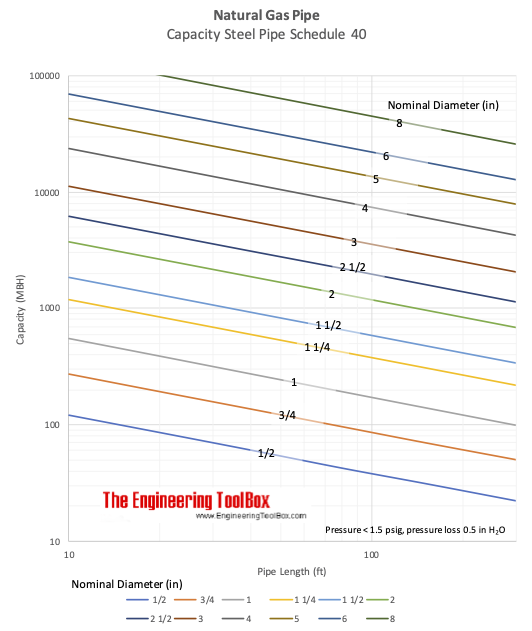
      This chart below is very helpful (a table above this chart lists the nominal and ID sizes for steel pipe, where nominal 3/4" = 0.824" ID).

      Note: 1 MBH = 1,000 BTUs/hour = approx 1 Cubic Foot (CF) for natural gas.

      So for any heater over 100,000 BTU, the delivery pipe *must* be 3/4" (0.8" ID). And for very long runs (e.g., across the house), 3/4" pipe may be marginal - even assuming that heater is the only device in-use.

      See: http://www.engineeringtoolbox.com/na...ing-d_826.html for more details.
      Last edited by Chris_B; 11-26-2010, 10:45 PM.

      Comment

      • woodturner
        Veteran Member
        • Jun 2008
        • 2049
        • Western Pennsylvania
        • General, Sears 21829, BT3100

        #33
        Originally posted by All Thumbs
        The 3/4" pipe recomendation is the I.D. of the pipe, not the O.D.
        For the Rheem and Paloma tankless heaters I considered, they specified 3/4" pipe, but it was the O.D. rather than the I.D.

        It's easy to answer this question for a specific heater - look at the size of the gas inlet to the heater. If the heater has a 1/2" I.D. inlet (like the ones that HD sells), there is no reason or benefit to using larger pipe.
        --------------------------------------------------
        Electrical Engineer by day, Woodworker by night

        Comment

        • woodturner
          Veteran Member
          • Jun 2008
          • 2049
          • Western Pennsylvania
          • General, Sears 21829, BT3100

          #34
          Originally posted by Chris_B
          So for any heater over 100,000 BTU, the delivery pipe *must* be 3/4" (0.8" ID).
          Thanks for researching that, and that number sounds reasonable.

          By the way, it's 100,000 BTU per hour - the rate information is needed to calculate rate of flow.

          However, a 100,000 BTU per hour heater is HUGE. 40,000 BTU/hr is more typical for whole house units.

          Another question - why does a 100K BTU/hr furnace only require 1/2" pipe?

          What pressure does that chart assume? Recall that PV=nRT. So it's not just pipe size, but gas pressure that determines volume. It appears that 10 " w.c. is pretty typical in most areas, which is not what the chart assumes.

          That chart makes other assumptions that are not applicable to residential gas lines.

          It's a good idea to engineer installations, but it's important to make sure the right information is used. Fortunately, the manufacture's engineer's have already figured this all out and both tell us the pipe size and provide an inlet to the heater that confirms the pipe size.

          If the gas line is run a very long distance, size MAY need to be increased. However, if the gas line run is that long, it's usually better to locate the heater closer to the gas line. Keep in mind that a tankless can be installed nearly anywhere - it does not have to be in the same location as the tank heater.

          BTW, a 100' run would be very unusual in a residential situation. Few of us have 10,000 square foot per floor houses (assuming the house is square) or even 5,000 square foot per floor houses (assuming a 100 x 50 rectangle).
          --------------------------------------------------
          Electrical Engineer by day, Woodworker by night

          Comment

          • All Thumbs
            Established Member
            • Oct 2009
            • 322
            • Penn Hills, PA
            • BT3K/Saw-Stop

            #35
            The pipefitter I spoke to said the reason tankless units may have smaller inlets is that they don't need everything a 3/4" line can supply. But the manufacturers know that people use gas for heating and cooking and clothes dryers, etc., and that if you don't upgrade to a larger line the other appliances may starve the hot water heater for gas.

            The tankless units apparently have a pressure switch and won't come on without sufficient gas pressure. When the furnace and oven are running, the pressure in the line drops and the better tankless units will actually throw an error code so you know why you aren't getting hot water.

            Edit: What is the big deal anyway? I've seen these run using those yellow flexible pipes, and what would it even cost to have black pipe installed? It can't be THAT bad, can it? I was thinking of having this done in bits and pieces, with having new black pipe installed. Then later I will get the hot water heater and put it in. I wouldn't feel comfortable running new black pipe (which I'd prefer to the flexible yellow stuff) and I don't want to pay a plumber $1500 to do the entire install. But if I can get new black pipe for $200 to $400, the rest I may be able to do myself.

            I'd even ask the pipefitter I've been talking to but he is clearly a loyal union man and would never take a side job that may step on a plumber's chance to make a buck. And I respect that. But I will ask him for a referral.
            Last edited by All Thumbs; 11-27-2010, 08:15 AM.

            Comment

            • LCHIEN
              Super Moderator
              • Dec 2002
              • 21981
              • Katy, TX, USA.
              • BT3000 vintage 1999

              #36
              Originally posted by woodturner
              For the Rheem and Paloma tankless heaters I considered, they specified 3/4" pipe, but it was the O.D. rather than the I.D.

              It's easy to answer this question for a specific heater - look at the size of the gas inlet to the heater. If the heater has a 1/2" I.D. inlet (like the ones that HD sells), there is no reason or benefit to using larger pipe.
              All this arguing about ID or OD of pipe needing to be 3/4" for carrying gas to the heater is beyond me. Because as the below article says, the 3/4" when they refer to any commonly used pipe has nothing to do with the actual measurable dimensions of the pipe.

              from http://www.gizmology.net/pipe.htm

              Notes on Pipe

              Oddly, there is nothing about a ½" pipe that is ½", be it copper, iron, or PVC. The outside diameter of copper is 5/8", and the inner diameter is either 0.527", 0.545", or 0.569", depending on the series. So-called ½" iron pipe is 0.840" outside diameter and 0.622" inside. PVC is the same outside as cast iron, but it is 0.608", 0.528", or 0.480" inside.

              If no dimension is ½", why call it ½" pipe?

              Well, it seems that back in the beginning of time - copper pipe was introduced in the 1930's - copper pipe was indeed standardized at the nominal diameter inside with a 1/16" wall, making it 1/8" bigger on the outside. As the metallurgy improved, allowing manufacturers to use thinner metal (and thus increase profits), they increased the inner diameter rather than decrease the outer diameter simply to allow the pipe fit existing fittings.

              As the manufacturers began to make bigger and bigger pipe, they found that 1/16" wall thickness was insufficient. Thus, the inner diameter of larger pipes is smaller than the nominal size, while smaller pipes are larger.

              Wrought iron pipe has a similar history, though I don't know the details. When PVC was developed, it inherited it's outside diameter from iron pipe.
              Loring in Katy, TX USA
              If your only tool is a hammer, you tend to treat all problems as if they were nails.
              BT3 FAQ - https://www.sawdustzone.org/forum/di...sked-questions

              Comment

              • woodturner
                Veteran Member
                • Jun 2008
                • 2049
                • Western Pennsylvania
                • General, Sears 21829, BT3100

                #37
                Originally posted by LCHIEN
                Because as the below article says, the 3/4" when they refer to any commonly used pipe has nothing to do with the actual measurable dimensions of the pipe.
                Thanks for the info. I did not know that :-)

                I just thought they were using "nominal" sizes. The "half inch" pipe I bought at HD has approximately 1/2" I.D. and the "three quarter inch" pipe specified by the tankless manufacturer had fit the threads and had the same I.D.
                --------------------------------------------------
                Electrical Engineer by day, Woodworker by night

                Comment

                • Kristofor
                  Veteran Member
                  • Jul 2004
                  • 1331
                  • Twin Cities, MN
                  • Jet JTAS10 Cabinet Saw

                  #38
                  Originally posted by woodturner
                  A couple of grand for the equipment itself? For a gas tankless? How long ago?

                  The highest price whole house gas tankless I could find in a quick search of the internet was around $1500, which would be $1050 after the tax credit. Power vent tank heaters start at around $800, $250 less net.

                  I feel like I'm missing something in your calculations - I'm not seeing the couple of grand cost difference (unless you are including the $1500 to $2000 cost of professional installation).
                  I replaced ours last February. I figured that in the winter we would need ~75 degree temperature rise if I was okay with running a 100% hot water mix at the shower/tap and preferably a bit more if I wanted the flexibility to fine tune the temperature at the point of use.

                  To support 2 showers at that rate I'd be looking at the biggest units HD has (~200K BTU, ($1200 today), + vent kit, + new gas piping). I don't have the comparison spreadsheet I had put together at the time but I seem to recall the prices were a couple hundred dollars higher so the total cost with vent kit and gas plumbing was pushing $2K. The federal rebate would have knocked a decent chunk off. I'm not sure if it would apply to the gas plumbing if I was DIYing the rest of the install but assume it does and the total cost would be ~$1400.

                  On February 26th I paid $724 for a 50 gallon power vent conventional water heater plus another ~$15 for some new valves and gas pipe dope. This unit was admittedly much less efficient than a tankless unit but still efficient enough to have an $85 rebate from the local gas company. So, total cost was ~$665 or a difference of over $720.

                  I don't know if the EF rating actually reflects energy required in a direct/linear way or not. If it does, going from an .64EF tank heater to a .8x tankless with a monthly water heating bill of ~$10-15 mean's I'd be saving $3-5/mo or $36-60/yr. Using the higher number break-even is at 12 years, using the lower 20. If you keep your anode in good condition the odds of a tank heater lasting 20 years are much higher than a tankless in my estimation. If you do need to make a repair I can DIY the repairs on a tank model, but probably not on a tankless.

                  Now, if you start with more comparable pricing at install (and admittedly I was buying in a hurry and didn't try very hard), then the lower operating costs from day one mean you could replace a tankless unit every 10 years and still come out on top while having consumed less resources. Particularly since the gas piping should be a one-time expense, and the venting may (or may not) be reusable.

                  Comment

                  • woodturner
                    Veteran Member
                    • Jun 2008
                    • 2049
                    • Western Pennsylvania
                    • General, Sears 21829, BT3100

                    #39
                    FWIW, this is the model I installed.
                    http://www.palomatankless.com/products/42/features.html

                    It consumes 118,000 BTU/hr and says it requires 1/2" gas line.

                    The manual for this model is not online but there is a manual for a slightly larger unit:
                    http://www.palomatankless.com/paloma...%20IO%20IM.pdf

                    HD sells the Paloma brand, which is made by Rheem.

                    They also have a page with sizing information
                    http://www.palomatankless.com/owners/more_sizing.html

                    Rheem also has an online sizing tool
                    http://www.rheem.com/Products/tankle...z_spec_sizing/

                    HD currently lists online the 6.4 gpm Rheem model for $798. This model is two steps up from the one I got, but if you have more than two showers or run both showers, the washer, the dishwasher, and the hot tub at the same time, you might need this unit.

                    In checking the warranty, it's 10 years on the heat exchanger, but only 3 years parts. However, the units are easy to work on and self-diagnose, so repair is not too difficult. Reliability ratings are high, though - I don't expect to have to repair it.
                    --------------------------------------------------
                    Electrical Engineer by day, Woodworker by night

                    Comment

                    • woodturner
                      Veteran Member
                      • Jun 2008
                      • 2049
                      • Western Pennsylvania
                      • General, Sears 21829, BT3100

                      #40
                      Originally posted by Kristofor
                      I don't know if the EF rating actually reflects energy required in a direct/linear way or not. If it does, going from an .64EF tank heater to a .8x tankless with a monthly water heating bill of ~$10-15 mean's I'd be saving $3-5/mo or $36-60/yr.
                      Thanks for the info.

                      I don't know if the rating is linear or not, either. I assume the efficiency applies during operation.

                      Let's suppose I use 30 minutes of hot water a day, and that the gas required to heat that volume of water is G. Let's compare a well insulated tank with a tankless. Let's say I have to reheat the water four times per day in the tank unit to maintain the temperature.

                      The gas required for the tank is 5G/.6=8.3G, assuming 60% efficiency
                      (heat once, reheat four times)
                      The tankless requires G/.9=1.1G

                      So, under these assumptions, the tank heater uses about 7.5 times the amount of gas. If the tank heater costs $15/mo to operate, the tankless would cost $2/mo, so the yearly savings would be $144, suggesting a four year payback - again, subject to these assumptions.
                      --------------------------------------------------
                      Electrical Engineer by day, Woodworker by night

                      Comment

                      • leehljp
                        The Full Monte
                        • Dec 2002
                        • 8764
                        • Tunica, MS
                        • BT3000/3100

                        #41
                        Originally posted by Kristofor
                        Now, if you start with more comparable pricing at install (and admittedly I was buying in a hurry and didn't try very hard), then the lower operating costs from day one mean you could replace a tankless unit every 10 years and still come out on top while having consumed less resources. Particularly since the gas piping should be a one-time expense, and the venting may (or may not) be reusable.
                        In 1990, our tank water heater in our Tokyo home was replaced with a large whole house tankless. Since our only gas usage was for the hot water, it was easy to note cost changes. Our organization paid for the tankless and installation, so I don't know the cost of that. However, I never will forget the cost of gas per month went from 18,000 yen down to 12,000 yen. That translated at that time to roughly $150. a month down to roughly $100.00 a month for 2 adults and 3 girls.

                        When we moved in 1992 to the Osaka area, our new house had three tankless units - Kitchen, upstairs bath, laundry room, and downstairs bath. Our gas bill there was about the same - 12,000 a month. Over the next 10 years our bill decreased about 1500 - 1800 yen for each girl leaving for college. (Water bill corresponded similarly.) After all the girls were gone, our gas bill started averaging 7000 - 7500 yen a month. That translates into an average of $70 - $75 per month on average for two adults in bath, laundry room and kitchen hot water usage.

                        When we moved to Toyota, the gas charges remained the same. So, for us, we could see an immediate savings on tankless vs tank type. In Japan, with very little natural energy resources, the energy consumption has driven the technology to tankless, which in turn has driven the tankless units down in price. I am sure that this will be the future in the US too.
                        Last edited by leehljp; 11-27-2010, 06:13 PM.
                        Hank Lee

                        Experience is what you get when you don't get what you wanted!

                        Comment

                        • Kristofor
                          Veteran Member
                          • Jul 2004
                          • 1331
                          • Twin Cities, MN
                          • Jet JTAS10 Cabinet Saw

                          #42
                          Originally posted by woodturner
                          Let's suppose I use 30 minutes of hot water a day, and that the gas required to heat that volume of water is G. Let's compare a well insulated tank with a tankless. Let's say I have to reheat the water four times per day in the tank unit to maintain the temperature.
                          It might kick on 4 times throughout the day when not in use, but that would be to warm the water up perhaps 5 degrees (or whatever the range is from set point), not the 80 degrees of heating needed for water entering the house.

                          Of course for 6-8 months out of the year in Minnesota the "wasted" heat is only partially wasted since it's dumped into air you'd otherwise be heating.

                          Originally posted by woodturner
                          The gas required for the tank is 5G/.6=8.3G, assuming 60% efficiency
                          (heat once, reheat four times)
                          The tankless requires G/.9=1.1G

                          So, under these assumptions, the tank heater uses about 7.5 times the amount of gas. .
                          That seems wildly high from numbers I've seen quoted which seem to range from a 25-50 percent savings.


                          Originally posted by leehljp
                          However, I never will forget the cost of gas per month went from 18,000 yen down to 12,000 yen. That translated at that time to roughly $150. a month down to roughly $100.00 a month for 2 adults and 3 girls.
                          That seems like the right ratio to me, you just had much higher energy rates. My October gas bill for hot water, and cooking (and which may have had a couple heating days on it, not sure), was 19 therms at ~$0.47/therm for the gas and delivery charge, or roughly $9 (The flat service charge and state sales tax was more than the cost of the gas). Incoming water will be a bit colder during Dec-Feb but not 50% colder.

                          Comment

                          • footprintsinconc
                            Veteran Member
                            • Nov 2006
                            • 1759
                            • Roseville (Sacramento), CA
                            • BT3100

                            #43
                            Originally posted by woodturner
                            FWIW, this is the model I installed.
                            http://www.palomatankless.com/products/42/features.html

                            It consumes 118,000 BTU/hr and says it requires 1/2" gas line.

                            The manual for this model is not online but there is a manual for a slightly larger unit:
                            http://www.palomatankless.com/paloma...%20IO%20IM.pdf

                            HD sells the Paloma brand, which is made by Rheem.

                            They also have a page with sizing information
                            http://www.palomatankless.com/owners/more_sizing.html

                            Rheem also has an online sizing tool
                            http://www.rheem.com/Products/tankle...z_spec_sizing/

                            HD currently lists online the 6.4 gpm Rheem model for $798. This model is two steps up from the one I got, but if you have more than two showers or run both showers, the washer, the dishwasher, and the hot tub at the same time, you might need this unit.

                            In checking the warranty, it's 10 years on the heat exchanger, but only 3 years parts. However, the units are easy to work on and self-diagnose, so repair is not too difficult. Reliability ratings are high, though - I don't expect to have to repair it.
                            i just realized that i have 1/2" piping.....roughly a 3/4" pipe OD (this is sold as 1/2" pipe). so the unit that i need would be the paloma 5.3 unit and they need 3/4 pipe, which i will have to plumb in.

                            2ndly, the HD has the 6.4gpm Rheem unit but its LP gas, not natural gas. The other units are larger....

                            i need to get 4.0gpm for two showers running at the same time (which does happen in our house) and maybe a dishwasher too, which would bump that number higher than 4
                            _________________________
                            omar

                            Comment

                            • woodturner
                              Veteran Member
                              • Jun 2008
                              • 2049
                              • Western Pennsylvania
                              • General, Sears 21829, BT3100

                              #44
                              Originally posted by Kristofor
                              It might kick on 4 times throughout the day when not in use, but that would be to warm the water up perhaps 5 degrees (or whatever the range is from set point), not the 80 degrees of heating needed for water entering the house.

                              Of course for 6-8 months out of the year in Minnesota the "wasted" heat is only partially wasted since it's dumped into air you'd otherwise be heating.
                              When I timed and measured the number of times my heater turned on and off, and the gas consumed, I, too, was surprised that it cycled so often. The 4 times a day was a convenient shorthand, based on these numbers. The more accurate way to be express it is that it cycles once per hour and uses .6G - but that's the same as the 4G shorthand (which is why I used the shorthand).

                              That seems wildly high from numbers I've seen quoted which seem to range from a 25-50 percent savings.
                              Again, it depends on one's usage patterns, and the quoted number assume a lot more usage than many people actually use, which makes the tank heater more energy efficient and the tankless seem less efficient. In other words, those numbers "cook the books" - unless that happens to be your usage pattern.

                              Since I installed this unit in Summer, when the only gas usage is the hot water, I know how much gas it is using, and I know how much the old heater used. During that period (before turning on the furnace), I used 11.89% of the gas used for the same period last year. In fairness, there is some tolerance in that measurement - we could have used a little more or little less hot water than last year, for example - but "less than 15%" is a pretty accurate number for the reduction in my gas consumption, for my usage patterns.
                              --------------------------------------------------
                              Electrical Engineer by day, Woodworker by night

                              Comment

                              • woodturner
                                Veteran Member
                                • Jun 2008
                                • 2049
                                • Western Pennsylvania
                                • General, Sears 21829, BT3100

                                #45
                                Originally posted by footprintsinconc
                                i just realized that i have 1/2" piping.....roughly a 3/4" pipe OD (this is sold as 1/2" pipe). so the unit that i need would be the paloma 5.3 unit and they need 3/4 pipe, which i will have to plumb in.
                                The Paloma 5.3 unit manual says it needs "3/4 inch black pipe" (see the gas installation section of the manual). By that they mean the pipe with 3/4" OD, sold as "half inch pipe" at HD and other stores. I went through that same confusion with the Paloma unit I installed. Double check the unit itself to make sure they haven't changed it, but your half inch pipe should be the correct size.

                                i need to get 4.0gpm for two showers running at the same time (which does happen in our house) and maybe a dishwasher too, which would bump that number higher than 4
                                But what temperature rise do you need? I understood the property is in Arizona, presumably in the desert. Your incoming water temperature is going to be high year round, so you won't need the temperature rise those of us in colder climates (like MN!) need. The sizing charts and tools are overly conservative and will overestimate the size, in part based on complaints from those who use them improperly.

                                As I said, for a draw of 4 gal/min, the 4.2 model (the one I got) is fine. The 4.2 number indicates it can supply 4.2 gal/minute, while the 5.3 model supplies 5.3 gallons per minute. IIRC, the rise at that rate is 40F. So, if you want 110F for showers, you would need an inlet temperature of 70F - IF you are really drawing at the flow rate.

                                I think the numbers have some cushion in them as well - my tankless has no trouble keeping up a 60F temp rise at 5 gallons/minute.

                                If it will really, really annoy you to run everything at once and get only hot rather than not steaming hot water, you should go with the larger unit. If you are willing to accept that rarely your water temp might be hot but not steaming, the smaller unit should be fine.

                                For me, I'd rather save the money and control usage to avoid that situation - but I don't have children at home to manage, either, so that approach may not work for everyone.
                                --------------------------------------------------
                                Electrical Engineer by day, Woodworker by night

                                Comment

                                Working...