-
-
Sycamore should cut fairly well; it's not a softwood - it's harder than poplar (it may be punky) .. Be sure that you are cutting "down hill" on the grain.
Speed isn't got to make all that much difference. Think about it - does the speed of a cabinet scraper across affect the finish? Nope. It's the angle, the relationship to the grain and the edge (burr). Same for a plane - a jack plane will do the same as high speed surface planer. - In the end the only variable on the output is the time it takes to remove x amount of wood.Guy Cox
Life isn\'t like a box of chocolates...it\'s more like a jar of jalapenos.
What you do today, might burn your butt tomorrow.Comment
-
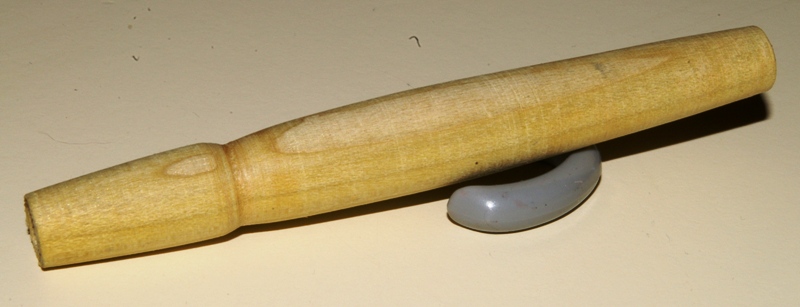
Here's where I am so far..
What I did was turn a block of poplar down to 5/8 so it would fit into my largest collet.
stuffed it into the collet and drilled through the center.
Then I mounted it between centers and went to town with the skew.
I finished up with a bit of sanding since I'm not a skew master yet
Practice for pen turning..
 William's Law--
There is no mechanical problem so difficult that it
cannot be solved by brute strength and ignorance.Comment
-
Good start... You can cut down on the rings appearing on the work by keeping the sandpaper moving back and forth. It may also be that you simply have not sanded it down enough. For spindle work, I usually start with 180-grit for roughing out, then to 400-grit for touching up, and then on to something even finer if the finish needs it. Use a good quality paper (I like Norton 3X), and use light-colored paper for light-colored woods.
Don't sweat the skew... It just takes a bit of practice. (And remember to always start on the work and run the skew off the ends, rather than ever starting at an end and working inward... a skew just won't forgive you for doing that...)Last edited by Uncle Cracker; 12-23-2009, 06:55 PM.Comment
-
Yeah It didn't take long to lean that a skew will only work well going down the taper..
Try to go up and you don't have taper anymore
My first skew practice was taking a 3" log, hit it with the gouge till it was round then worked the skew going left and right till I had something about 1/2"..
Made a heck of a mess
As for the sanding all I did was hit it with some coarse emery cloth I had handy from working on metal pieces. I need to dig into the supply box to find the real paper..
Thanks for the tip on light paper. I wouldn't have thought of that.
I"m looking at finishes now.. What thickness CA do you use for the BLO/CA finish?Last edited by sscherin; 12-23-2009, 10:47 PM.William's Law--
There is no mechanical problem so difficult that it
cannot be solved by brute strength and ignorance.Comment
-
I've used medium as well. I tried the thick with less luck. I also am learning the CA finish, and I usually would finish at the same speed I finished turning at. When watching some videos, I finally realized the demonstrators were slowing their lathe down a bit to apply the CA. One video specifically mentioned needing to do that.Comment


Comment