

I have a left tilt table saw and I need to bevel the edges of a workpiece. On a right tilt saw, I can just tilt the blade with the fence set at the width of the workpiece, and the bevel will be perfect because the width is already set and the blade tilts in. Since the blade tilts away from the fence on a left tilt saw, how do I figure out where the cut line will be? How can I measure to cut a perfect bevel on a workpiece on a left tilt saw? How do I know where to set the fence so I cut off the right amount for the angle, but not cut off to much? The only scarp will be whatever is cut off from the bevel, but the width is already set on my board. Does this make any sense?
-
-
Left tilt
To my way of thinking you can put the fence to the right side of blade,size limited?The bitterness of poor quality lingers long after the sweetness of low cost is forgotten! -
To know exactly, depending on which fence you have and which side of the blade you place the fence, you can perform a simple test.
Take a small scrap piece of a size that you know, like 7", and then set the angle of the blade. Set the fence for a measured cut like 6" either on the rail scale, or measure to the closest tooth at the table height to the fence. Make the cut, and see what the measure is. This will give the difference in the cut and what the rail measure is so you can figure it the next time.
Keep in mind that the test may be for the short edge of the angle, or the long point (it depends on where on the angle your measurement needs to be taken). This test will account for any differential between the rail measurement and what your set measurement is. This also works for figuring fall off pieces that you need the complimentary angle on (by figuring in the blade thickness).
.Comment
-
You can also draw a pencil mark for your bevel on the wood, place the wood on the table, and stand behind the blade to line it up. Takes a while, but you only have to do it once for your set of cuts, right? Always err on the side of caution, better to cut it twice than too short once.
Two others ways to do it that I can think of, may not work in your situation.
If you have a straight-edge long enough, you can measure from the inside edge of the fence to the top of the blade, which would give you the outside dimension.
Or put the fence on the left, so you have the outside dimension face down, and can measure between the fence and the blade effectively. Definitely not good if your fence is cocked to the right.Comment
-
Please don't put the fence on the side that the blade tilts towards and cut a bevel. It is exceptionally dangerous as the piece is trapped between the blade and the fence and if it gets out of kilter ever so slightly, can cause serious injury (and the need for clean shorts at a minimum).
When cutting bevels with the fence:
left tilt blade, keep the fence on the right.
right tilt blade, keep the fence on the left.Mike
Lakota's Dad
If at first you don't succeed, deny you were trying in the first place.Comment
-
If you're cutting a 45 degree bevel, the top side of the cut will be longer by the thickness of the stock.
You can probably use the Pythagorean formula for other angles.
http://en.wikipedia.org/wiki/Pythagorean_theoremComment
-
1. Tilt the blade to the angle you want.
2. Put a piece scrap of the same stock between the center of the blade and the fence.
3. Put your ready to bevel workpiece on top of the scrap and touching the blade, then slide the fence to touch the workpiece and lock it.
4. Cut.Comment
-
The method Just Started describes is the one I use. It works regardless of stock thickness or blade angle, with no math or test cuts or similar fooling around. Keep in mind that if you change the workpiece thickness or blade angle, any previous tests or calculations you may have done become irrelevant. With this method, the only requirement is that you have a spacer piece of the same thickness as your workpiece.
After positioning the fence with this method, I generally nudge the fence just a skosh closer to the blade -- say a strong 32nd or so -- to ensure that I'll get a nice, sharp point on the longer side of the bevel. This presumes, obviously, that losing that small amount of width won't affect the way the project goes together.Last edited by LarryG; 05-02-2008, 09:58 AM. Reason: had two words transposed; and added some more infoLarryComment
-
My post is adding nothing but this whole thread is why I have a very large set of bevel bits for my router table. I can't remember when I last tilted the blade on my saw.Comment
-
WHAT HE SAID!!
You've got plenty of suggestions to your query....but I shuddered a bit when I read your post.
Before I knew better, I cut a few bevels with the blade tilted towards the fence. There was some binding, but I was lucky and no kickback occurred. I won't do it again.Mike
Drywall screws are not wood screwsComment
-
Mike
Lakota's Dad
If at first you don't succeed, deny you were trying in the first place.Comment
-
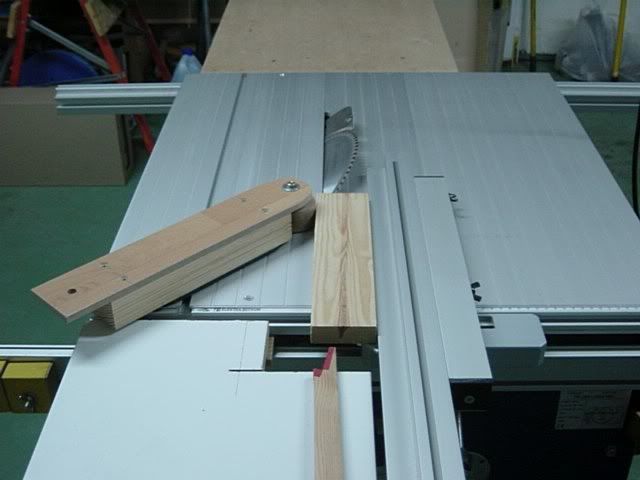
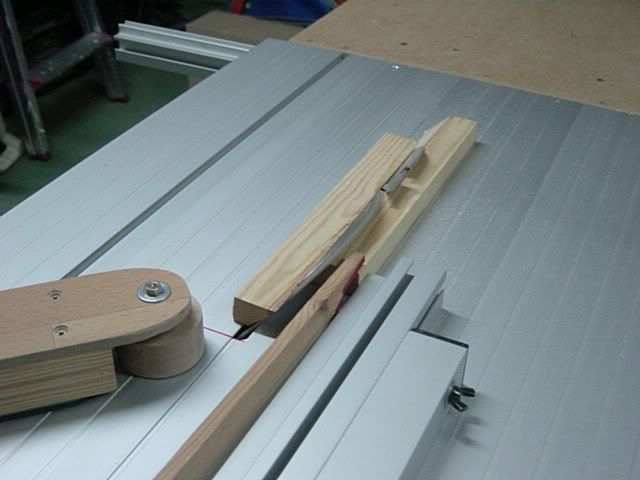
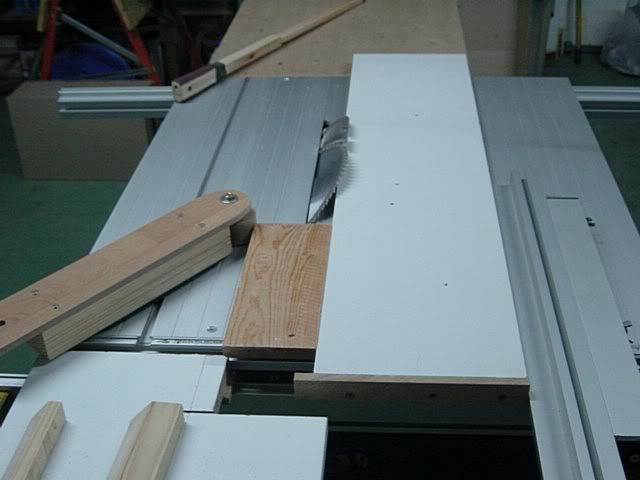
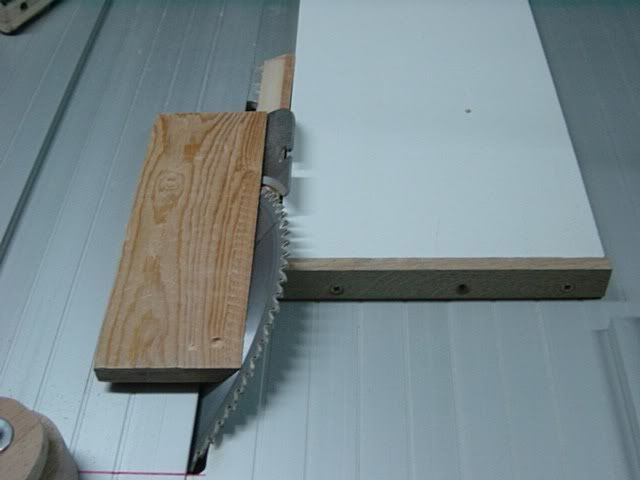
Regards
nikiComment
-
I think the OP's question was referring to a method of having a fence measure to go by, or an accurate way to determine where to set the fence for a left tilt.
To determine this it is necessary to establish a point of reference of the fence to the blade. There may be bevels to be cut and then the blade may have to be set back to 90 deg, then the fence moved to the other side of the blade for some cuts, and then more bevels to be cut which puts you back to the point of having to have a spacer the same thickness as the workpiece. The new cuts may be on a different thickness, which would require you to do that procedure all over again.
So, whatever test cuts, math, or whatever fooling around you do one time to establish that point of reference is part and parcel of IMO, good woodworking techniques. Setting up the piece to a pencil line allows the differential of the thickness of the pencil line. Using the set-up as a quick solution doesn't provide the confidence of a measured scale. For doing many cuts at different times requiring changing blades, from side to side, I would prefer to do what was necessary once and know where to set the fence later, instead of having to do a set-up each time.
For fences that have a hairline index indicator for a scale on the rail, it's necessary just to check the actual correct measurement each time a blade has been swapped.
I'm all for trying quick solutions or shortcuts when they don't risk accuracy. I like to depend on methods that have previously worked. If woodworking was a hobby for me, maybe my methods might be different. Having to earn a living at it keeps me focused of what my mistakes cost me in terms of time and materials.
.Comment
-
C-man, I'm sure you are correct, especially for a full-time pro, but I am just starting out with woodworking as something to keep my brain from melting down in front of the idiot box now that I'm retired. I have never done any cuts similar to this but just thought about the question for 30 seconds and pictured a quick and easy solution, just the way my mind works.Comment
-
I've had spontaneous brainstorms (believe it or not) that sometimes worked out great. What the forehead slapper is after doing a procedure many times, to all of a sudden think of a much easier way. Sometimes we are so close to a problem we don't see an obvious alternative. Safety is still foremost in the methodology. If you have thoughts that a procedure isn't safe, it's time to rethink it.
.Comment


Comment