

Maybe someone can clear this up for me, what is the difference between a riving knife and splitter? My TS (ridgid 3650) has a blade guard/splitter assembly that tilts with the blade. Would this be considered a riving knife?
-
-
No, that's a splitter and a guard. A riving knife sits directly behind the blade, travels up and down with the blade, as well as bevels. The shark guard includes a riving knife that also sits just below the top of the saw blade. This allows you to remove the guard and leave the riving knife in place for non-through cuts.
The shark's clamp allows you to do this in a matter of seconds. Most saws sold in the US do NOT have riving knives.Keith Z. Leonard
Go Steelers! -
So what is the exact definition of a riving knife. Is the only difference that it moves up and down with the blade? Just trying to understand. Thanks!Comment
-
That's pretty much it...the difference is that moves up and down with the blade, and is typically positioned a little closer. They essentially accomplish the same thing, but a riving knife is a more elegant and effective solution.Originally posted by ryan.sHappiness is sort of like wetting your pants....everyone can see it, but only you can feel the warmth.

Comment
-
it moves up and down with the blade AND tilts with the blade.Originally posted by ryan.s
Your wording of "the only difference is" indicates that there might not really be much signicance between the two except for that, but the fact is there is a huge difference in safety. Many European countries REQUIRE this on machines built or sold there for the safety difference over a splitter.
Because Riving Knives raise and lower with the blade, the riving knife can be shaped to fit curved just about 1/4 to 1/8 inch away from the back circumference of the blade itself, and that puts the knife much much closer to the blade at all times than does a splitter, thereby preventing more kickbacks.Hank Lee
Experience is what you get when you don't get what you wanted!Comment
-
I think you just nailed it. All the riving knives I've seen are curved to the blade, while splitters are usually straight.Originally posted by leehljpMike
Lakota's Dad
If at first you don't succeed, deny you were trying in the first place.Comment
-
Not to pick on you Mike, but to clarify for the OP, there are several aftermarket and shop built splitters that are straight, but every stock splitter I've ever seen looked curved very much like this Delta pic:Originally posted by Russianwolf
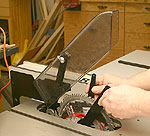
Several aftermarket splitters are curved too:

 Happiness is sort of like wetting your pants....everyone can see it, but only you can feel the warmth.
 Comment
-
a square is a specific version of a rectangle.
My defs have a riving knife being a specific version of a splitter.
A splitter is a thin pece of metal placed behind the blade mounted to the saw to keep the wood from closing up and pinching the blade hence redicing kickbacks. Somtimes the splitters are connected to the tilt mechanism allowing the splitter to be used for both vertical and beveled cuts.
A riving knife is a splitter placed behind the blade and mounted not only to the saw but specifically the elevation and tilt mechanisms so that the riving knife rises falls, and tilts with the blade. Taking advantage of this property allows a knife to be placed in very close proximity to the blade following the curvature of the blade and being a fraction of an inch from the blade. Loring in Katy, TX USA
If your only tool is a hammer, you tend to treat all problems as if they were nails.
BT3 FAQ - https://www.sawdustzone.org/forum/di...sked-questionsComment
-
Just to clarify the words "the only difference is" was referring to difference of the splitter assembly on the TS3650 vs the riving knife. In my original post I mentioned that my blade guard/splitter assembly does bevel with the blade.Originally posted by leehljpComment
-
Thanks Loring! Very concise clear definition. Makes sense now.Originally posted by LCHIENComment
-
Being that "riving" is a word more often read than heard, I'm not 100% sure of the pronunciation...is the first "i" long as in "live" or short as in "live"?
Isn't the english language fun? Mike
Mike
Drywall screws are not wood screwsComment
-
haha - live or live.Originally posted by mschrank
Eye! (to the first question)
Aye! (to the second question)
English. so much fun...Last edited by LCHIEN; 08-03-2006, 09:39 AM.Loring in Katy, TX USA
If your only tool is a hammer, you tend to treat all problems as if they were nails.
BT3 FAQ - https://www.sawdustzone.org/forum/di...sked-questionsComment
-
I've always heard it pronounced with a long first "i" as in "ryving"Originally posted by mschrank
Ray.Did I offend you? Click here.Comment
-
I'm pretty sure it rhymes with "tomato."LarryComment
-
Think bee hive.
Did you read that or is it something you read?
A splitter is not even necessarily metal. The little MJ splitters are polycarbonate and guys have used wood for these as well.
These two terms are so often generalized and swapped out that it is indeed difficult to pinpoint exactly what one or the other is.
There are different types of splitters made of different types of materials that do different things.
Then there are different types of riving knives. Some with more versatility than others.
The absolute deciding factor of whether you are looking at a splitter or a riving knife is whether it rises and falls with the blade.
All riving knives do this. Riving knives function as splitters, but are simply designed to be far better at doing the job of a splitter.LeeComment


 LCHIEN


Comment