Cut corners then, now re-do

Collapse
This topic is closed.
X
X
 
  • Time
  • Show
Clear All
new posts
  • radhak
    Veteran Member
    • Apr 2006
    • 3061
    • Miramar, FL
    • Right Tilt 3HP Unisaw

    #1

    Cut corners then, now re-do

    Feel like a dolt, but that doesn't help .

    Last year I made a lumber cart based on similar ones others here had made and displayed. I resized it to suit my needs : 8 feet long and just 30" tall (before adding the base/ castors). Looks like this :
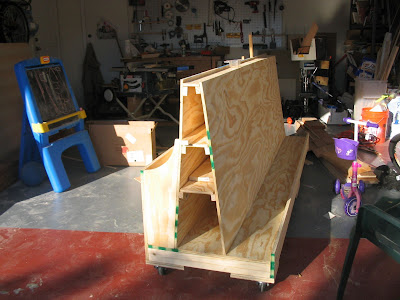


    These are the bins on one side for the cut-offs :
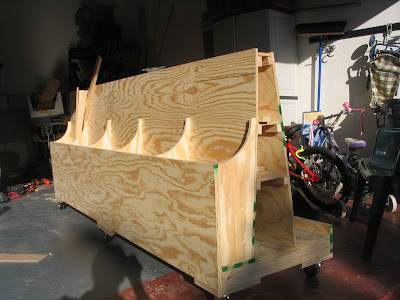

    ( I used 6 castors)

    And the ply sheets go on the other side, with the center cubbies for furring strips, mouldings, etc.
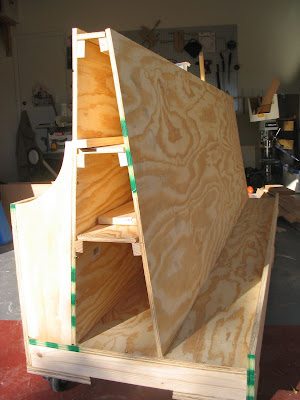


    I remember that I started out building this without taking a good inventory of the stock I wanted to use for this, and found late in the evening that part of the ply i wanted to use was 1/2" thick instead of 3/4". I was too lazy to run to HD, and thought thinner ply would keep the total weight down (and feeling a bit miserly wanted to re-use whatever i had), so decided to judiciously use the thinner ply. Ended up using it for the two slanted sides (the sides of the 'A' shape). With hindsight, a bad choice .

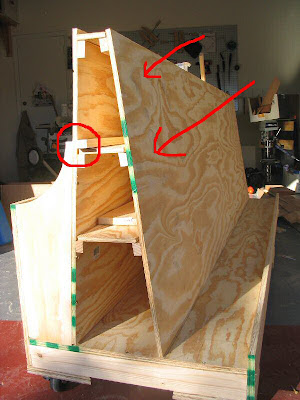
    A year later, I see that the weight of a couple of sheets of full-sized ply have begun to bend the structure at the weakest point - circled in red (The arrows to show the force of the weight of the ply sheets):

    (please see image in my next post).

    The nails holding the cleats and shelfs in the middle are coming apart. Fortunately, I used no glue, so am in a position to correct this, hopefully with minimum effort.
    My thoughts are, I need to :
    (a) knock off the shelfs with a hammer, allowing me to open the structure up
    (b) remove the cleats, then add a new sheet to the one on the left. This way I get more than enough strength, and also don't need to take apart the bins on the left side.
    (c) while I am at it, I might as well replace the right sheet with a 3/4" one.

    Hmm, think about it, how about I just put the right side sheet to the left, to make the left side a total of 1" thick, and put a new sheet on the right.
    Would that be enough? Or is it time to cut my losses and go with newer, thick sheets altogether?
    Last edited by radhak; 09-03-2007, 09:58 AM.
    It is the mark of an educated mind to be able to entertain a thought without accepting it.
    - Aristotle
  • LCHIEN
    Super Moderator
    • Dec 2002
    • 21992
    • Katy, TX, USA.
    • BT3000 vintage 1999

    #2
    probably just need screws if the joints are coming apart (nails pulling out)
    I don't think that large sheet of ply leaning against the small sheet of ply should cause structural failure - the force is well distributed.

    unless i misunderstand where its failing...
    Loring in Katy, TX USA
    If your only tool is a hammer, you tend to treat all problems as if they were nails.
    BT3 FAQ - https://www.sawdustzone.org/forum/di...sked-questions

    Comment

    • radhak
      Veteran Member
      • Apr 2006
      • 3061
      • Miramar, FL
      • Right Tilt 3HP Unisaw

      #3
      for whatever reason the last image in the prior msg did not show up right :


      I think the failure is really the thinner ply bending at the first 'fulcrum' it gets as it's not strong enough.
      It is the mark of an educated mind to be able to entertain a thought without accepting it.
      - Aristotle

      Comment

      • Anna
        Senior Member
        • Feb 2006
        • 728
        • CA, USA.
        • BT3100

        #4
        Why not just add (short) horizontal stretchers between the two sides, connecting the cleats together and creating something like a grid under the shelves? Unless I'm misunderstanding the problem, too.

        Comment

        • cbrown
          Established Member
          • Feb 2006
          • 127
          • Massachusetts
          • BT3100

          #5
          How about some vertical cleats running up the bowing (left) side, along the outside edge of the outer cutoff bins (and some around the middle bin if you feel like it). I would think that even 1x3 cleats would give you enough reinforcement to keep the plywood flat , 2x3 if you want to be sure.

          --Chris

          Comment

          • jackellis
            Veteran Member
            • Nov 2003
            • 2638
            • Tahoe City, CA, USA.
            • BT3100

            #6
            I see the problem. Thicker ply wood might help but it appears most of the weight of the plywood you're storing on the card is against the top of the thinner plywood sheet because its too short, which is why the cleat is coming loose. But for the cart storage space you'll lose, I'd suggest nailing or screwing 2" or 3" strips of plywood or 1x pine to the outside where you store sheet goods to stiffen it. Other alternative is to place stiffeners on the inside and lose some of that storage space (and also have to to a lot of trim work inside.

            If you end up replacing the two large "vertical" 1/2" plywood pieces, make the whole thing 48" tall so there's no bending moment at the top. Also, you might make the sides of the bins for cutoffs 12-18" taller and make sure they are secured to the bottom of the cart. That will also stiffen things a bit.

            Comment

            • footprintsinconc
              Veteran Member
              • Nov 2006
              • 1759
              • Roseville (Sacramento), CA
              • BT3100

              #7
              i 've been thinking of making a system like this one aswell and it may be soon or maybe not - i dont know, too many things to do my list.

              can you post a close up of the area that you are talking about (circles and arrowed) because i cant seem to see what is going on. if at all possible, can you take a picture of the frame under all this (the base of your storage unit) so that i can see where your wheels and how you framed the bottom to take the loads to the wheels. maybe then i can comment on what i think is going on.

              thanks

              oh, by the way, how wide is the unit?
              _________________________
              omar

              Comment

              • LCHIEN
                Super Moderator
                • Dec 2002
                • 21992
                • Katy, TX, USA.
                • BT3000 vintage 1999

                #8
                I was told by a caster manufacturer not to put 6 casters on my wood cart. Bad idea they said. I think its because 99% of the time, due to whatever unevenness in the floor, 100% of the weight will be on 3 or 4 casters. It will never spread evenly over six, if that was the intention.
                Loring in Katy, TX USA
                If your only tool is a hammer, you tend to treat all problems as if they were nails.
                BT3 FAQ - https://www.sawdustzone.org/forum/di...sked-questions

                Comment

                • radhak
                  Veteran Member
                  • Apr 2006
                  • 3061
                  • Miramar, FL
                  • Right Tilt 3HP Unisaw

                  #9
                  Good suggestions, all.

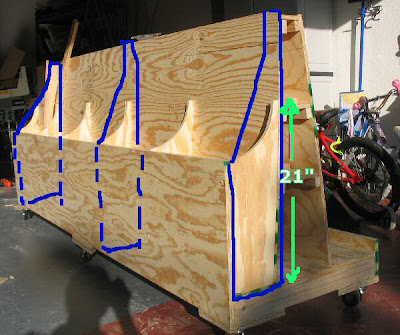
                  Now I realize the fact that, of the 30" high side , only 21" is supported by the curved sides of the cutoff bins, allowing the larger portion of a 48" sheet to weigh down on the upper, unsupported panel of 1/2" ply, weakening it at that point and bending it backwards (towards the cutoff bin).
                  ( I need to take a pic to make it clearer, later today)

                  I think I could pick up on the easiest of the suggestions and add additional curved supports on the left side within the bins, and take these all the way to the top, like the the blue sketch in here :


                  I agree, it would have been better to have a height of 48", but my workshop space dictates this.

                  the width of the cart is 30".

                  Loring, i added the 5th/6th caster only after a lot of thought. my garage is really uneven, but these two allow me to easily push/pull the cart; far easier than if there were 4. I guess most of the times only 4 touch the ground, but maneuverability is better.
                  It is the mark of an educated mind to be able to entertain a thought without accepting it.
                  - Aristotle

                  Comment

                  • mpc
                    Veteran Member
                    • Feb 2005
                    • 1008
                    • Cypress, CA, USA.
                    • BT3000 orig 13amp model

                    #10
                    Yup, the low height makes any stored plywood sheets really push on the very top portion of the cart... where your bins aren't acting as re-inforcement. Your idea of extending the bins with taller curved sections (blue line sketches) will really make a positive difference.

                    Another thing that will help is to add "shear web" pieces. If you look at the sides of the cart, you've got a "A" shape (with multiple horizontals... a funky "A" but basically an "A" none the less)... Use flat plywood scraps to tie the vertical plywood pieces together, nailed/screwed (or even better: glued, splined, etc.) to those pieces AND to the shelf pieces & shelf supports. Make the upper edge of these web pieces line up with your shelf boards so the shelves still work; you'll just rob a little height from the shelf below it. Hard to describe... think of those "Burro" style sawhorses at the BORG; the end caps of those are the same idea.

                    Another option if you can stand a little non-wood in the project: metal angle extrusions screwed to the corners of your cutoff bins. Just run a few vertical metal 90 degree pieces in place of those extended curved sections you've drawn.

                    mpc

                    Comment

                    • cabinetman
                      Gone but not Forgotten RIP
                      • Jun 2006
                      • 15216
                      • So. Florida
                      • Delta

                      #11
                      I've made many racks both for wood/plywood, and large sheets of glass. Having your cubbie dividers run to the top and having them act as a side brace will stiffen that side considerably. The cross pieces that connect to the slanted side should have the angle cut on that side. What will make a difference in overall rigidity is to gusset the openings on both ends, which basically stop any angular movement. It can be done on the underside of the shelf at each opening, acting as a brace.

                      The six casters aren't a factor. They will offer more support than four. Not to hijack this thread, thought I'd show a simple sheet mover. The glass/sheet plywood dollies I made (to move one sheet at a time) was basically a 2x4, 5'-6' long with a 1" wide groove 1/2" deep down the middle. There are 6" long 2x4's in the middle attached edgewise, with a rigid caster on each one. On the ends of the long 2x4 is a swivel caster. This was to move a heavy sheet across the shop by one person. I also made a smaller hand version for that same purpose:
                      .

                      Comment

                      Working...