Pre-drilling/Countersinking holes

Collapse
This topic is closed.
X
X
 
  • Time
  • Show
Clear All
new posts
  • ryanps
    Forum Newbie
    • Dec 2006
    • 68
    • Maumee, Ohio
    • ShopFox W1677

    #1

    Pre-drilling/Countersinking holes

    I've never really known the proper way to pre-drill a hole for a screw.
    Say I have a #8 Flat head screw that is 1-1/4" long. My #8 drill-bit/countersink is re-positionable so that the countersink portion can be positioned anywhere along the length of the bit -- should I set the countersink 1-1/4" up the length of the bit? Should it be set for 1"?
    Many thanks in advance.
    Ryan
  • Warren
    Established Member
    • Jan 2003
    • 441
    • Anchorage, Ak
    • BT3000

    #2
    Are you using a wood screw? If so, the diameter of the hole in the first piece of wood should be the same as the diameter of the unthreaded part of the screw shank. The hole in the second board needs to be smaller than the diameter of the threads. This is done so that the screw will pull the second board towards the first. I usually drill the shank hole in the first board, and if I'm not using the drill press, then position the second board and drill a pilot into it. I counter sink, or bore for a plug as a third operation before putting in the screw. The counter sink may be for a plug or just to seat the head of the screw below the surface of the wood. This is all usually done on a drill press where practicable.

    If I'm working quick and dirty, say a one time jig or some such, I just use a pilot hole and drive the screw flush. When required I might use a bit/countersink combo so as to put the head of the screw below the surface of the wood.

    Is this more than you wanted to know?

    Also to be taken into consideration are the characteristics of the wood and the type of screws. And you thought it was a simple question with a simple answer.
    A man without a shillelagh, is a man without an expidient.

    Comment

    • LCHIEN
      Super Moderator
      • Dec 2002
      • 22023
      • Katy, TX, USA.
      • BT3000 vintage 1999

      #3
      Originally posted by ryanps
      I've never really known the proper way to pre-drill a hole for a screw.
      Say I have a #8 Flat head screw that is 1-1/4" long. My #8 drill-bit/countersink is re-positionable so that the countersink portion can be positioned anywhere along the length of the bit -- should I set the countersink 1-1/4" up the length of the bit? Should it be set for 1"?
      Many thanks in advance.
      Ryan
      I drill the hole at least as deep as the screw, so in your case at least 1-1/4" deep.
      A tiny bit short won't hurt too much but don't forget you usually sink the flat head screw in a little deeper than flush.
      Loring in Katy, TX USA
      If your only tool is a hammer, you tend to treat all problems as if they were nails.
      BT3 FAQ - https://www.sawdustzone.org/forum/di...sked-questions

      Comment

      • cabinetman
        Gone but not Forgotten RIP
        • Jun 2006
        • 15216
        • So. Florida
        • Delta

        #4
        Warren gives you a good take on wood screws. Personally, I don't use them. I prefer the coarse thread drywall type. The shank is uniformly straight and threaded all the way up. The gullets are deep, and the threads are sharp and widely spaced. When predrilling/pilot/countersinking those type screws, this is the method I use for screws that aren't tapered, like wood screws.

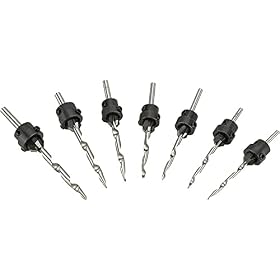
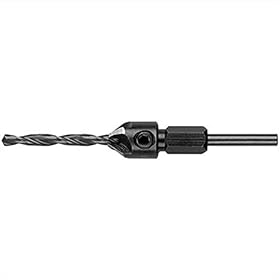
        I use a drill countersink combination bit that has a movable countersink cutter on the bit. Some brands have the drill bit as a tapered bit. Some have a stop (depth guide) as a part of the countersink. I use mostly a bit that the drill bit part mounts in the drill, like this:

        There is also the type of countersink that has the hex shank for quick mount in drill chuck holder. I don't prefer these as there is usually a little play in the hex shank in the holder. On these I would mount the hex shank directly into the chuck.

        I usually drill the pilot part of the hole short of the seated screw depth so the first few threads have a solid field. The countersink depth is set to allow the head to seat just below the surface. Depending on the specie of wood, the harder woods won't allow the head to pull much deeper that the depth of the countersink. Some brands of screws have little nibs under the head to allow for "drilling" so to speak. Actually what the screw does is to grind away a portion of the wood as it's driven in.

        As for the pilot hole width and countersink sizes, they are usually numbered or sized for the screw size you are using. The pilot hole should not be larger than the shank of the screw. A tip for seating the screws: As the screw gets tightened down the last few turns should be just bumped tightened to prevent over tightening which could lead to a stripping of the screw threads in the wood. I've found a cordless drill works better than a corded one. This may sound funny, but in slowing down an electric drill to have slow speed control of the torque, the torque of the drill gets compromised when run at a slow speed.
        Last edited by cabinetman; 04-08-2007, 04:20 AM.

        Comment

        Working...