I've been cutting tenons using a dado blade and miter gauge. Is there a need for a $60 tenoning jig when tenons can be cut with a dado blade? Does the tenoning jig produce cleaner tenons?
If what you do works, then fine, no need to reinvent the wheel. Sometimes, we think we need expensive gadgetry to get the job done. Until then what you do is fine.
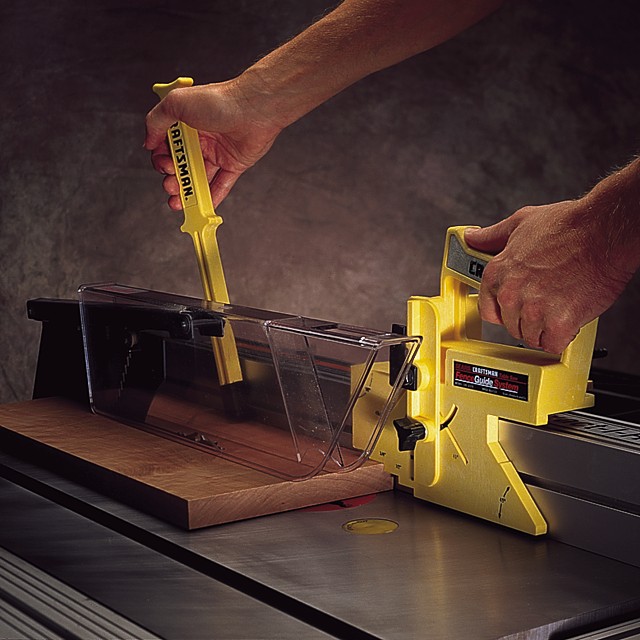
I've done both but I get the best results with a tenoning jig. You get much smoother cheek cuts with a tenoning jig and it's alot easier to sneak up on the perfect fit. It's only recently that I bought one of the heavy cast iron tenoning jigs and I wouldn't trade it now.....but....it doesn't get used all that often and for years and years I got by almost as well with shop built tenoning jigs that ride the fence and this plastic unit that Sears sells
This one is $19. I'd still be using it but it won't open up enough to fit the fence on my Griz. Pat
Woodworking is therapy.....some of us need more therapy than others. <ZERO>
The answer to your question likely depends upon what dado set you are using. If your dado stack does not produce flat bottoms, has bat wings, etc then your tennons are going to be pretty inferior to tenoning jig results. If you have an awesome dado stack like the Forrest Dado King or Freud Dial A Width, then your tennon checks are going to be just fine.
I use both methods with no problems. Of course I usually cut the tennons slightly over sized and hand plane to snug fit which takes care of any milling issues.
Like Popeye, a cast-iron tenoning jig is a relatively recent acquisition for me. I do prefer using it to a dado set or nibbling; but I'm not so sure that my favorite tool for exposing tenons doesn't remain what I've used most often, which is the band saw. If you make the shoulder cuts the same depth on all four sides, you can really fly through a stack of similar workpieces because there's no clamping mechanism to slow you down. Just dial in the fence setting using test pieces, position a stop block to control the depth of cut, and you're off to the races.
It is likely that even the $60. jig will likely give you cleaner results than what you are doing now. Keep in mind that the shoulders are more critical than the smoothness of the cheeks. As long as you are getting a good glue bond between the mortise and tenon the inside beauty probabaly will not matter.
I use a jig that slides on the rip fence and has a clamp built in. I use the micro-adjuster for my rip fence to slowly nibble up to the correct dimension. It is not terribly fast but isn't slow either. Sometimes I use a dado set but I prefer the RAS for that (I am limited to 1/2 inch of dado blades but that isn't a huge limitation).




 Black wallnut
Comment