speaker hole with router?

Collapse
This topic is closed.
X
X
 
  • Time
  • Show
Clear All
new posts
  • gychang
    Established Member
    • Jan 2006
    • 188
    • Sacramento, California
    • none

    #1

    speaker hole with router?

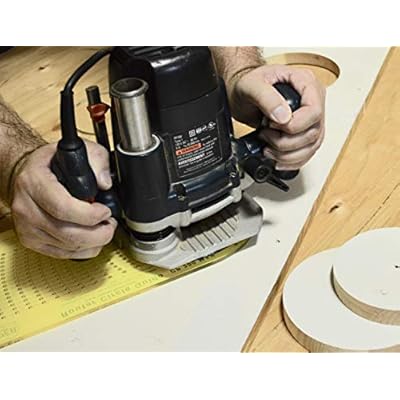
    I plan to buy a router, can it cut a round hole without much trouble?, is there a picture of how this is done without buying an expensive accessory?

    thanks in advance.

    gychang
  • AndyF
    Forum Newbie
    • Aug 2003
    • 56
    • Victoria, Texas, USA.

    #2
    Originally posted by gychang
    I plan to buy a router, can it cut a round hole without much trouble?, is there a picture of how this is done without buying an expensive accessory?

    thanks in advance.

    gychang

    I have one of these, Jasper 400 Circle jig:
    http://www.amazon.com/gp/product/B00...185747?ie=UTF8

    and works very well making holes for speakers. You'll find the increments, 1/16", very useful making speaker holes.

    You mount the jig to the base of your router, drill a 1/8" hole in the center where you want the hole, insert the pin in the hole on the jig for the desired diameter, place router/jig/pin in hole in material, and start cutting. It's best to use a plunge router and make multiple passes at deeper depths (about three passes for 3/4" material).


    Andy
    Last edited by AndyF; 08-20-2006, 04:23 PM.

    Comment

    • Knottscott
      Veteran Member
      • Dec 2004
      • 3815
      • Rochester, NY.
      • 2008 Shop Fox W1677

      #3
      Some circle cutting jigs aren't overly expensive and make the task simple. It's not too hard to build one either. You can also use a pattern bit to cut a circle by following a circular template.


      Happiness is sort of like wetting your pants....everyone can see it, but only you can feel the warmth.

      Comment

      • LCHIEN
        Super Moderator
        • Dec 2002
        • 21992
        • Katy, TX, USA.
        • BT3000 vintage 1999

        #4
        I would do it like this without the expensive (overpriced) jig:

        say you want to cut a 10" hole. 5" radius.
        Get a 1x4 maybe 9- 10" long
        Drill a 1/4" hole in your workpiece centered where you want the 10" hole.
        Drill a 1/4" hole 1" from one end of the 1x4
        get a 1/4" sprial upcut bit ($15 or so)
        Get a 1/2" router bushing or other convenient size and mount to the router.
        Cut a 1/2" hole in the 1x4. It should be centered 4-7/8" from the 1/4" hole (this allows for the 1/8" radius of the 1/4" bit)

        Now place a 1/4" dowel 1" long in the hole in the workpiece and place the
        1x4's 1/4" hole over this. Make sure you can swing the 1x4 all the way rotating around this pin.

        Place the router with the bushing and bit in the 1/2" hole. with the bit just above the workpiece, practice swinging the router around 360°. You should hold the handles of the router to keep one side of the router to you as you rotate and the router will rotate in the 1x4.

        If that works fine, lower the bit to make a 1/8" deep cut. Start the router above the 1x4 and lower the bushing into the hole (or plunge it in if you have a plunge router), make the rotation.
        Repeat, dropping the bit 1/8" each pass until you cut through. You don't really want to cut more than 1/8" per pass or you'll end up breaking bits at $15 each.

        You'll want to have the workpiece fastened to a sacrificial piece since the last cut will score whatevers below it. Also be prepared that the center will become loose when you cut thru, watch out that it doesn't shift and allow the router to ding your circle since the center anchors your router. You might want to secure the workpiece to the table or sacrificial piece, double stick tape will secure both the final piece and the cutout..

        Simple, really. You can replace the 1/4" hole and dowel pin with a nail and a hole sized for the nail and temporarily nail the 1x4 to the workpiece center.
        Anyway you saved $35 on the circle jig.

        If you are making multiple sepeakers and holes, you can use the first one as a template and use a pattern bit (1/2" straight cutter with a top or bottom flush bearing) to cut the rest if you don't want to repeat this.

        Good luck and let us know how it goes.
        Last edited by LCHIEN; 08-20-2006, 05:09 PM.
        Loring in Katy, TX USA
        If your only tool is a hammer, you tend to treat all problems as if they were nails.
        BT3 FAQ - https://www.sawdustzone.org/forum/di...sked-questions

        Comment

        • cabinetman
          Gone but not Forgotten RIP
          • Jun 2006
          • 15216
          • So. Florida
          • Delta

          #5
          The easiest way to do a round hole is to first make a template with a hole that is the width of the cutting edge (on a straight bit) to the edge of the base plus the diameter of the desired hole size. In other words, you're going to make a hole in a larger piece that the edge of the base of the router will ride against and the bit will cut the desired size. The pattern can be as thin as 1/4" and will be a square with a hole in the middle, that can be done with a jig saw, then sanded smooth. In fact, if you only have a few to do, maybe a jigsaw will be sufficient. If you don't own a jigsaw to make any of the holes, figure out what size you want your template hole to be, and drive a nail through a panel into a backing that will be your template and measure how much of a spacer you need to ride against the nail to the edge of the router base to equal the diameter needed. When doing this, make sure the panel is secured to something below like another panel, and the center (the piece being cut out) is also secured, because you will be cutting all the way through.


          "I'M NEVER WRONG - BUT I'M NOT ALWAYS RIGHT"

          Comment

          • BigguyZ
            Veteran Member
            • Jul 2006
            • 1818
            • Minneapolis, MN
            • Craftsman, older type w/ cast iron top

            #6
            You can easily make a jig yourself. However, I 've used the Jasper 400 jig and have had very good results. I like the fact that it is set for very fine increments and everything is already done for you. If it's a one-time deal, make your own. If you're going to make a hobby of building speakers, buy the Jasper.

            HTH

            Comment

            • gimpy
              Established Member
              • Nov 2004
              • 197
              • Flagstaff, AZ.
              • BT3100

              #7
              gychang, I have read a lot of very good reports on the jasper jig, but do not have one. How big is the hole(s) you wish to rout? FYI, their are 2 separate size jasper jigs that are made. One is for larger holes and another one for smaller holes (2 or 3 inches in diameter, maybe--just guessing). So, if you want to rout small holes be sure and get the right one.

              I have made two different jigs for routing holes. It is not real hard to do (not if I can do it). For me and my router (a Ryobi 2 hp plunge), this is how I would/did do it:

              The base of my Ryobi has a horizontal hole on each side of it that is there to hold the edge guide. I bought two lengths of threaded rods (could use wooden dowels) about a foot or two long. Put each of these rods in these two holes and tighten them down (this is also where you adjust your radius for the hole). The other end of these rods I connected to a squareish piece of wood (about 2 x 2 x 3 or 4 inches long) by drilling holes through it that matched these rods (diameter and height from the bottom). I attached nuts to both sides of the rod/wood to hold it in place in the wood. Then drill a hole down through the top and in the middle (center of the two rod holes) of this piece of wood to hold your pin/nail/screw to the work piece.

              That's all there is to it. This works on my Ryobi. I don't know (but would think) that other brand routers with edge guides would be similarly easy to make. With mine, I don't have to change/make router bases. The only thing to make is the piece of wood at the rod ends. You can make the hole as large as you want just by using longer rods/dowels.
              Hope this is not too hard to understand.

              Frank
              Frank, "Still the one"

              Comment

              • bigsteel15
                Veteran Member
                • Feb 2006
                • 1079
                • Edmonton, AB
                • Ryobi BT3100

                #8
                The baby Triton comes with a circle jig in the case.
                Brian

                Welcome to the school of life
                Where corporal punishment is alive and well.

                Comment

                • meika123
                  Senior Member
                  • Dec 2002
                  • 887
                  • Advance, NC, USA.
                  • BT3000

                  #9
                  I've always had good results using Norm's circle cutting jig. Easy to make, and very functional.

                  Dave in NC
                  Stress is when you wake up screaming and then you realize you haven't fallen asleep yet.

                  Comment

                  Working...