

 LCHIEN
Yeah the press is full of bad information. When they talk about technical topics I know and understand I see so many errors. If they have the same error rate on other topics I have an overall sketicism of stuff on which they report.
Case in point:
A recent article about the nuclear plant issues, one reporter in a respectable publication quoted an "expert" who said basically that the nuclear industry has for years accepted a risk estimate of one meltdown per 10,000 reactor years. He went on to say the equivalent of 500 reactors have been operating an average of 30 years now (my note: that equates to 15,000 reactor-years of experience) and there have now been at least 3 partial melt downs (TMI, Chernobyl, and Fukushima) so that the actual rate is now 1 in hundreds. Actually I'm inclined to count fukushima as three partial meltdowns but still 3/15,000 or 5 in 15,000 is only 1 in 5000 or 1 in 3000. Is the reporter who is reporting on technical stuff not smart enough to see the total error in this guy's calculations or understand what he is reporting to be wrong?
Another case in point also relating to the nuclear incident:
A publication reported yesterday on the report of radioactivity found in the seawater 300 meters from Fukushima being 1250 times more radioactive than normal. But he said that the radioactive iodine would break down and be gone in 8 days (apparently referring to the half life of Iodine 131). Anyone who remembers his high school physics and exponential decay knows that the iodine does not go away in 8 days, only half of it is gone in 8 days so that after 8 days, the radiation will only be 625 time normal and after 16 days, 312 times normal. Sounds a whole lot worse, eh?
Now there's an issue of whether the reporter is at fault here or if his source is at fault. Who bears the responsibility if the source makes a glaring error easily spotted by a technical person who is NOT even an expert in the field? Is the reporter simply reporting or should he have asked for clarification? Is he not responsible for finding expert spokespersons? Either way it makes everything published tainted by its lack of correctness.
I use knowledge of things I understand to calibrate someone who is telling me stuff about it. So when reading about things I don't understand in the least If they failed to impress me I won't believe much of what they are saying. I only wish news organizations had technical reviewers...
Case in point:
A recent article about the nuclear plant issues, one reporter in a respectable publication quoted an "expert" who said basically that the nuclear industry has for years accepted a risk estimate of one meltdown per 10,000 reactor years. He went on to say the equivalent of 500 reactors have been operating an average of 30 years now (my note: that equates to 15,000 reactor-years of experience) and there have now been at least 3 partial melt downs (TMI, Chernobyl, and Fukushima) so that the actual rate is now 1 in hundreds. Actually I'm inclined to count fukushima as three partial meltdowns but still 3/15,000 or 5 in 15,000 is only 1 in 5000 or 1 in 3000. Is the reporter who is reporting on technical stuff not smart enough to see the total error in this guy's calculations or understand what he is reporting to be wrong?
Another case in point also relating to the nuclear incident:
A publication reported yesterday on the report of radioactivity found in the seawater 300 meters from Fukushima being 1250 times more radioactive than normal. But he said that the radioactive iodine would break down and be gone in 8 days (apparently referring to the half life of Iodine 131). Anyone who remembers his high school physics and exponential decay knows that the iodine does not go away in 8 days, only half of it is gone in 8 days so that after 8 days, the radiation will only be 625 time normal and after 16 days, 312 times normal. Sounds a whole lot worse, eh?
Now there's an issue of whether the reporter is at fault here or if his source is at fault. Who bears the responsibility if the source makes a glaring error easily spotted by a technical person who is NOT even an expert in the field? Is the reporter simply reporting or should he have asked for clarification? Is he not responsible for finding expert spokespersons? Either way it makes everything published tainted by its lack of correctness.
I use knowledge of things I understand to calibrate someone who is telling me stuff about it. So when reading about things I don't understand in the least If they failed to impress me I won't believe much of what they are saying. I only wish news organizations had technical reviewers...
 Loring in Katy, TX USA


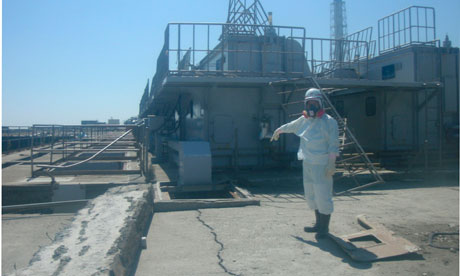 (Reuters picture)
Comment