Scared Myself Good or Don't Try This at Home

Collapse
This topic is closed.
X
X
 
  • Time
  • Show
Clear All
new posts
  • TB Roye
    Veteran Member
    • Jan 2004
    • 2969
    • Sacramento, CA, USA.
    • BT3100

    #1

    Scared Myself Good or Don't Try This at Home

    With the addition of my Grizzly Jointer to my collection of Shop tools, it became apparent that I needed to rearrange the garage. I reconnected some wire that had been not used when I had a work bench in the garage. and started patching the drywall prior to painting. Before I painted I wanted to drill the holes for the lumber rack I bought. Using a stud finder I had found the studs I wanted to use. Unknown to me the previous owner had run some wire across the top of the wall for some electrical outlets out the side garage door and for the photo cell for the front garage lights. While drilling a pilot hole for the 1/4" lag screws I felt some resistance and just pushed a little harder on the drill. Next thing I knew there was aloud Pop and some sparks. Luckily I was using a drill with a plastic case and was standing on a wooden ladder. I cut the power to the house and then cut open the dry wall to see what the damage was. I had drilled through 2 cables and dead center in the stud. I cut the wires and cut the bad pieces out and capped the end of the cable. I then turned the power back on and made sure the circuit breaker for the two wires was off. My nieces partner is an electrician and will be coming over to help fix the mess. Learned my lesson next time I drill and feel resistance I will stop and check things out. I am going to get a new stud finder that finds the electrical wire also. The previous owner ran a lot wire to different parts of the house so I had better be careful. Now I have a bigger dry wall repair to make. The circuit breaker panel you see on the wall is for the garage wiring and also sends the power to another box in the shop. The damaged wiring goes to the main box outside by the meter.

    Tom
    Attached Files
    Last edited by TB Roye; 02-12-2007, 05:44 PM.
  • Black wallnut
    cycling to health
    • Jan 2003
    • 4715
    • Ellensburg, Wa, USA.
    • BT3k 1999

    #2
    I guess the previous home-owner never knew about the plates that are supposed to go onto studs over wires. I'm not sure what they are called but I used them in my shop when I did my wiring. But come to think of it I think there might be some rule about how far from the edge of the stud the wire must be before their use is optional...hmmm I guess I'll look that up tonight.
    Donate to my Tour de Cure


    marK in WA and Ryobi Fanatic Association State President ©

    Head servant of the forum

    ©

    Comment

    • TB Roye
      Veteran Member
      • Jan 2004
      • 2969
      • Sacramento, CA, USA.
      • BT3100

      #3
      The owner used the plates. I just pushed harder when I felt resistance. Drilled the plate and the stud dead center. The plate is rusty and dark thats why it is hard to see.

      Tom

      Comment

      • cabinetman
        Gone but not Forgotten RIP
        • Jun 2006
        • 15216
        • So. Florida
        • Delta

        #4
        Our house is about 50-60 years old and all walls except one hallway wall are CBS block. In one of the bedrooms that is now an office, I was hanging wall shelves with standards and brackets.

        Using a masonry bit, and not in alignment with any outlet, while drilling holes for the standards I drilled exactly between the two wires of a 110V line and it went POP, and blew the breaker. Really, the chance of doing that in a all block wall is a distant one. So there I was with the remains of the wire, in a wall that was all faced with mortar. Wound up using butt connectors as there was no way to pull more wire or get any slack.

        So much for following the building codes of the fifties.

        Comment

        • JSCOOK
          Senior Member
          • Sep 2006
          • 774
          • Kitchener, Ontario, Canada
          • Ryobi BT3100-1

          #5
          I've got a rather expensive Zircon Stud scanner which also detects metal, electrical and has an option for deep scanning ... it's alright, but can bee a little finicky, and has at times made me second guess it's accuracy for electrical.

          As I'm always involved in some sort of project ... and after a freak accident a few years back were I was juiced by 220V (and live to tell about it)... I recently tried a GB (Gardner Bender) tester called "LiveWire" and have been amazed at it's accuracy, and sensitivity that can be adjusted with a simple thumb dial ... it can be used for 12-600V ... It's all I use now for checking for live wires before drilling or ensuring the breaker is off ... and fits in the pocket like a large marker or pencil.

          GB LiveWire Tester
          Last edited by JSCOOK; 02-12-2007, 09:17 PM.
          "Experience: that most brutal of teachers. But you learn, my God do you learn". by C.S. Lewis

          Comment

          • Ed62
            The Full Monte
            • Oct 2006
            • 6021
            • NW Indiana
            • BT3K

            #6
            It's amazing how you can drill through something like that, but if you were actually trying to do it, it couldn't be done in a hundred years.

            Ed
            Do you know about kickback? Ray has a good writeup here... https://www.sawdustzone.org/articles...mare-explained

            For a kickback demonstration video http://www.metacafe.com/watch/910584...demonstration/

            Comment

            • Richard in Smithville
              Veteran Member
              • Oct 2006
              • 3014
              • On the TARDIS
              • BT 3100

              #7
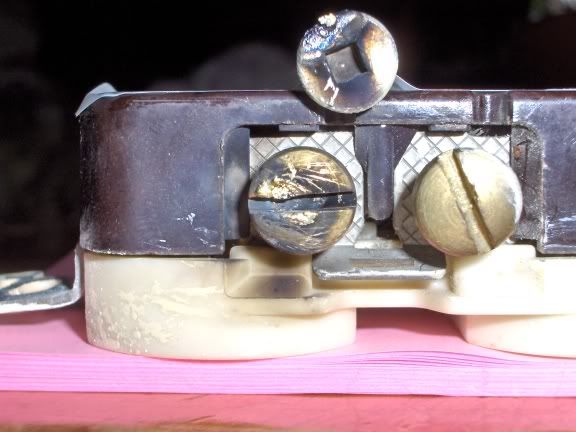
              Scary stuff when you get into old wiring. A few months ago my daughter plugged into an outlet in her bedroom and popped a fuse. I went to replace the fuse and it blew while I was screwing it in. After changing my drawers, I started the process of pulling out everything in the bedroon to trace a short. I found it.

              What you see is a screw that held the outlet box to the wall. It moved just close enough to arc to hot conection to the outlet. I'm just glad my fuse panel worked.
              From the "deep south" part of Canada

              Richard in Smithville

              http://richardspensandthings.blogspot.com/

              Comment

              • crokett
                The Full Monte
                • Jan 2003
                • 10627
                • Mebane, NC, USA.
                • Ryobi BT3000

                #8
                Glad to hear you weren't hurt. Some years ago we were repairing some termite damage in my dad's 1850's farm house. We pulled the living room floor and were pulling the joists so we could dig out the crawlspace before we put the new floor in. I was working a staple out that held the wire to the A/C unit.

                The joist crumbled (termite damage) and I fell forward and managed to stab the line with a screwdriver. 240V will take a tip off of a flat-blade screwdriver.
                David

                The chief cause of failure in this life is giving up what you want most for what you want at the moment.

                Comment

                • Slik Geek
                  Senior Member
                  • Dec 2006
                  • 708
                  • Lake County, Illinois
                  • Ryobi BT-3000

                  #9
                  I guy I worked with cut a length of zip cord (lamp cord) with diagonal-cutting pliers. To his surprise, the cord was plugged into a live 120V outlet. Bright flash, loud pop. The cutters now looked like wire strippers for lamp cord!

                  Comment

                  • scorrpio
                    Veteran Member
                    • Dec 2005
                    • 1566
                    • Wayne, NJ, USA.

                    #10
                    Gotta hand it to the guys who do electric welding - working with an electric arc on a regular basis. When I need to do welding, I personally prefer an acetylene+oxygen rig.

                    Comment

                    • bhornberger
                      Established Member
                      • Jan 2003
                      • 204
                      • Webster Groves, Mo, USA.
                      • Craftsman 22104

                      #11
                      that picture reminded me of a saying an old timer told me... white to silver, black to brass, otherwise you'll land on your ***

                      Originally posted by Richard in Smithville
                      Scary stuff when you get into old wiring. A few months ago my daughter plugged into an outlet in her bedroom and popped a fuse. I went to replace the fuse and it blew while I was screwing it in. After changing my drawers, I started the process of pulling out everything in the bedroon to trace a short. I found it.

                      What you see is a screw that held the outlet box to the wall. It moved just close enough to arc to hot conection to the outlet. I'm just glad my fuse panel worked.
                      Brent

                      Comment

                      • burrellski
                        Established Member
                        • Dec 2005
                        • 218
                        • Saint Joseph, MO.

                        #12
                        I work as an engineer for a company that designs/manufactures equipment for the utility industry. I can (unfortunately) attest to the horrific injuries caused by electricity. When you are talking about the voltages we deal with, accidents are often fatal.

                        The things I've seen through work give me a unique perspective on home electrical. I do most everything myself, but it's always with great care.

                        Comment

                        • BigguyZ
                          Veteran Member
                          • Jul 2006
                          • 1818
                          • Minneapolis, MN
                          • Craftsman, older type w/ cast iron top

                          #13
                          I've had a few run-ins with electricity. One of the most recent was working in my garage. I was running a brand new 20 amp line to power the door opener and the lights (previously power was run via two extension cords, which were connected to eachother between the house and the garage).

                          I had just drilled the hole in the garage wall, and run all of the conduit. I cut into the wire to trim off the excess with the wire cutter part of a wire stripper, and suddely there was a huge BANG and a shower of sparks. I stood there for a half second, dazed. The sparks landed on the sawdust from the hole I drilled and started on fire. I kicked out the flames, dropped the wire strippers, and immeadiately went to the basement where the breaker box was.

                          I know I had turned off the line that I have run to the garage, however one of my renters must have thought the breaker was for their apt or something, because the box was open.

                          Needless to say, I now use masking tape with warnings marked on it to notify anyone when I'm working on a project.


                          The most scary experience though has got to be when I was interning at a local plastics company. We were doing the first run using a system I built to test the particle deposition on plastic surfaces. The testing setup was mounted to a plastic cheet, and was sitting on a metal rack. The engineer and I were trying to get the thing to work, when I touched the metal rack and felt a huge pop. My ears started ringing, and I felt dazed. Basically, there was some sort of short with the power supply we were using and the cart- which was ungrounded- built up an electrical charge much like a capacitor. So it was a high voltage, low amperage shock that I recieved. Kinda like walking on carpet and touching a doornob- but multiplied a thousand times.

                          Comment

                          • Hellrazor
                            Veteran Member
                            • Dec 2003
                            • 2091
                            • Abyss, PA
                            • Ridgid R4512

                            #14
                            You don't fear electric, you respect it.

                            I've will admit I do not with working in large capacity stuff though. The worst job I helped on was feeding wire for a 400A breaker into a 3 phase panel that had around 4000A per leg. While the whole thing was energized...

                            Respected it like a red headed step child watching his step father carry a 4' bamboo pole...

                            Comment

                            • jseklund
                              Established Member
                              • Aug 2006
                              • 428

                              #15
                              I think a healthy dose of respect is acquired by anyone who knows anything about electricity. While you will most likely walk away from 117V currents found in U.S. homes- you still need to respect them for the sheer amperage that could be pumped through in the wrong situation. I'll do outlets/lighting, but I won't connect anything to either end of the box as long as I can help it. Even at 117V, the power company will pump an unlimited amount of electricity through your body, and then charge you for it to boot! Talk about insult to injury.

                              The other thing to watch out for with electricity, as many have mentioned, is HEAT. A lot of electical injuries are not carried out the way people fear (electrocution). It is actually due to lower resistance (shorting, metal, etc.) being introduced and molten metal or other hot material catching fire and burning people. You can learn this with a car- 12V electricity in a car will get your attention, but is unlikely to seriously hurt you. However- if you drop a wrench across the terminals on a battery you'd better get out of dodge quick!
                              F#$@ no good piece of S#$% piece of #$@#% #@$#% #$@#$ wood! Dang. - Me woodworking

                              Comment

                              Working...