

I got this one.
http://www.hartvilletool.com/product/11355
I like it.
True you may need a pilot hole, but what I did was machine an adjustable counter weight to use when I wanted to avoid a hole.
Stable and accurate.
And if your just looking to make a set of toys, circle cutters are alot faster then the band saw + sanding, router set up or what have you.
(P.S. the micro adjustable function of this cutter is worthless, as when you tighten the set screws your measurement falls off. tolerance is loose)
-
Getting in here late, and not much to add about general use that hasn't already been mentioned. I will say tho', now that you've mentioned your inteneded use, I seriously doubt if you're going to be pleased with this setup for a "production run". While it will cut nice holes, it is an EXTREMELY slow process. A much better idea would be to use the circle cutter to make templates for use with a router and guide bushings. For that matter tho', you could just use the router and a circle jig to make the patterns.
Or, another route you could go is to use the BS to rough cut the circles, then use a pattern and flush trim bit to 'polish' them up.
You'll have to decide what will work for you, but I personally wouldn't use a circle cutter for an extended run of multiple pieces.Last edited by Thom2; 04-11-2007, 09:54 AM.Leave a comment:
-
Check out my post in tool reviews regarding the Jasper Circle jig.
They make a smaller one perfect for your projects.
GaryLeave a comment:
-
with the router I would use a pivot pin hole in the sub base instead of a template...or just a board with a series of pivot pin holes for each radius that you want to cut at the proper distance from a 3/4" hole for a guide bushing. This would also work good for any arcs or arches that you want to cut...Leave a comment:
-
Again thanks for all the comments -- you've given me a lot to think about.
I am just thinking through building a set of building blocks and a toy box as a gift for a nephew. The set has lots of squares, rectangles, arches, arcs, triangles, pillars, wheels, and other shapes I need to fabricate. I am going to use hard maple and other woods. I am trying to find a way to cut arches, arcs and other round shapes without too much hassle, waste and cost.
Certainly, my band saw would be fine for all this -- presuming that I can get the thing tuned correctly, learn how to use it properly, and cut cleanly, and, and, and ...
Alternatively, a really gigantic forstner big bit will do the job, but precious wood would decorate the floor. Besides, these bits cost a small fortune.
As luck would have it, my drill press can go as low as 380 rpm so this tool might be a option. It sounds like these cutters are fairly inexpensive, so I can give it a try. If it isn't stable or scares me too much, I can go always go the bandsaw route.
Thanks.
GregLeave a comment:
-
I've got the General, and I have been very pleased with the quality of holes. I carefully honed the cutter, following the tips in an issue of ShopNotes from a couple years ago. And I always run it at the lowest speed possible on my drill press.
I've had better results with the cutter than with a router. (Perhaps my router template moved slightly under load?)Leave a comment:
-
According to WOOD Magazines Drill Press Speed Chart the recommended RPM speed for circle cutters is;
1½" - 3" circle, 500 RPM's for softwoods and 250 RPM's for hardwoods
3¼" - 6" circle, 250 RPM's for both softwoods and hardwoods
1½" - 6" circle, 250 RPM's for acrylicLeave a comment:
-
I'm not sure what type of project you're working on, but I've cut circles and holes that size (3-6") a lot quicker, neater and safer using my router instead of the fly cutter.
GregLeave a comment:
-
I would think the maximum speed depends in part upon the location of the cutter. Set for small circles (like 1-2 inches) you could cut higher RPMs
but for larger circles (like 3-6") you would use less than the maximum because the linear velocity of the cutter itself would be much higher (proportional to the radius).
Most 2-3" cutters like rosettes, big forstners etc recommend 200-300 RPM range on a D.P. I wouldn't think you could turn a circle cutter set for 3" much faster.
Aside from cutter tip velocity, you also have an un-balanced assembly spinning around and the end of the beam spinning around at its maximum length no matter where the cutter is.
I think the safe RPM is the biggest concern I'd have.
Between 2- and 3 inches I use a 1-1/2 to 2.125" inch forstner and a few passes with a router equipped with rabbeting bits and flush trim bits to enlarge the holes perfectly. Ask me if you need more info.
Once it gets past about 3 inches I start thinking about a router and circle jig.Last edited by LCHIEN; 04-09-2007, 02:54 PM.Leave a comment:
-
-
...and be careful. (Or did someone already mention that?)
Random points:
If you want a wood circle, it'll have a pilot hole in the middle.
These cutters make good holes, too, but you need to orient your cutter differently than for a circle.
You can have a good circle, or a good hole, but not both. (At least, not without further work.)
...and be careful.
Regards,
TomLeave a comment:
-
Thanks for the responses. I'll will be very careful with the speed and other pitfalls as suggested.
I am not sure my drill press can go slow enough for one of these. I'll check before I buy or use one of these circle cutters.
Cheers!
GregLeave a comment:
-
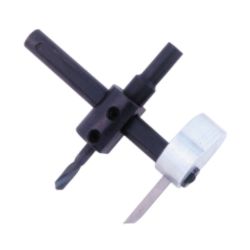
One of these, I presume (one shown from Sears' website, probably made by General).
Also variously called a circle cutter, beam cutter, fly cutter, wing cutter.
Follow all the precautions that Dr D, and Larry suggested.
If you are going to 3-6" then I really strongly suggest RPMs not in excess of about 250 RPM. Many drill presses won't go this slow! The ones with two pulleys (not three) generally only go down to around 600 RPM, which I would think is too fast for this kind of bit at that diameter. The 12- and 15-speed DPs with three pulleys of 4-5 steps each often go down to the 200's of RPMs.
Be safe, clamp and watch out for that swinging beam, it'll reach out and grab ya.Last edited by LCHIEN; 04-09-2007, 11:01 AM.Leave a comment:
-
I bought one at Woodcraft last summer to cut some speaker cutouts. It worked well and cut clean holes. That said, they can be dangerous. +1 on Dr. Dave and Larry's comments about the low speed. Use the slowest speed on you drill press. I used a speed ~200 RPM I think. Also, some places sell the cutters with two different size ranges, so make sure you get one that covers all the sizes that you need.
JimLeave a comment:
-
+1 on Dave's comments. Mine is made by General, which is one of the brands of budget-but-decent carpenter's/woodworker's tools. I think I paid maybe ten or twelve bucks for it at Lowe's.
In addition to a slow spindle speed, clamp your workpiece down SECURELY and keep your hands and clothing well clear. Wing cutters are pretty scary just watching the things run ... definitely not something you want to have a fleshy encounter with.Leave a comment:


 LCHIEN


Leave a comment: