How do I wire this?

Collapse
This topic is closed.
X
X
 
  • Time
  • Show
Clear All
new posts
  • Stytooner
    Roll Tide RIP Lee
    • Dec 2002
    • 4301
    • Robertsdale, AL, USA.
    • BT3100

    #16
    There is an art to wiring elements in boxes. You might not think so, but after watching guys that know what they are doing compared to those that are new at it, you can really tell a difference.
    Not only in the time it takes, but the finished product just screams professional when done right.
    I am only adequate and somewhere middle of the road. Those boxes should work for you as long as you have plenty of room around the box to work.

    When it comes to wiring boxes, like most everything, having the right tools is half the job. If you use good tools and techniques, it can be a pleasurable job.
    Poor tools and techniques can be an effort in futility. Best advice I can give is to lay everything out. Assemble all the tools you think you might need. Get comfortable and take your time.
    Then test all the circuits with a multimeter once completed.
    Lee

    Comment

    • ivwshane
      Established Member
      • Dec 2003
      • 446
      • Sacramento CA

      #17
      Originally posted by Stytooner
      There is an art to wiring elements in boxes. You might not think so, but after watching guys that know what they are doing compared to those that are new at it, you can really tell a difference.
      Not only in the time it takes, but the finished product just screams professional when done right.
      I am only adequate and somewhere middle of the road. Those boxes should work for you as long as you have plenty of room around the box to work.

      When it comes to wiring boxes, like most everything, having the right tools is half the job. If you use good tools and techniques, it can be a pleasurable job.
      Poor tools and techniques can be an effort in futility. Best advice I can give is to lay everything out. Assemble all the tools you think you might need. Get comfortable and take your time.
      Then test all the circuits with a multimeter once completed.
      It's definitely an art and it's something I thought about getting into but it seems to top out quickly. I struggle getting everything in the box nice and neat even if there is plenty of room! I also haven't found a good and quick way to get the wire around the screw nice and tight before screwing it down.

      Comment

      • Stytooner
        Roll Tide RIP Lee
        • Dec 2002
        • 4301
        • Robertsdale, AL, USA.
        • BT3100

        #18
        I don't think there is anything wrong with using the push in contacts on the back. That is if you have the correct size wire.
        It can really help in a loaded box situation.

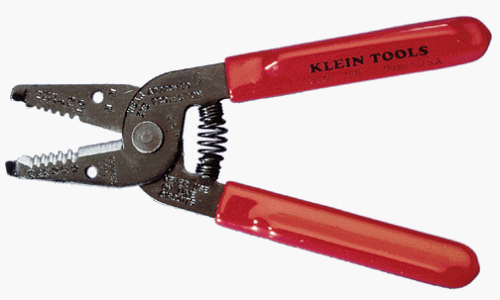
        I make my hooks quick and dirty using one of the holes in the jaws of my strippers. Stick the wire in just a bit and give the tool a twist. Then use the plier tip to give it a bit of an offset. Slip the loop on the screw and then crimp with the same plier end.

        Lee

        Comment

        • cabinetman
          Gone but not Forgotten RIP
          • Jun 2006
          • 15216
          • So. Florida
          • Delta

          #19
          Originally posted by Stytooner
          I don't think there is anything wrong with using the push in contacts on the back. That is if you have the correct size wire.
          It can really help in a loaded box situation.

          I make my hooks quick and dirty using one of the holes in the jaws of my strippers. Stick the wire in just a bit and give the tool a twist. Then use the plier tip to give it a bit of an offset. Slip the loop on the screw and then crimp with the same plier end.

          I've done that too. I also use a needle nose pliers, and the loop forms nicely across the top of the nose. If a screw is backed out just enough to get the wire to rest against the shank, I've been lucky enough to get it to be wrapped around the shank. Then, tighten the screw.

          .

          Comment

          Working...