Can anyone here read Japanese?

Collapse
This topic is closed.
X
X
 
  • Time
  • Show
Clear All
new posts
  • Alex Franke
    Veteran Member
    • Feb 2007
    • 2641
    • Chapel Hill, NC
    • Ryobi BT3100

    #1

    Can anyone here read Japanese?

    I've been scanning some 100-year-old photos from my grandfather's trip to the Far East. A couple of them have signs in Japanese, and I'm very curious about what they actually say. Would anyone here be willing to help translate them for me?

    Click on the thumbnails for larger versions of the images...
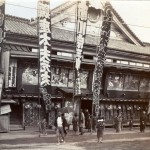

    Caption: "Japanische Singspielhalle" (Japanese music hall, or operahouse)
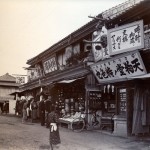

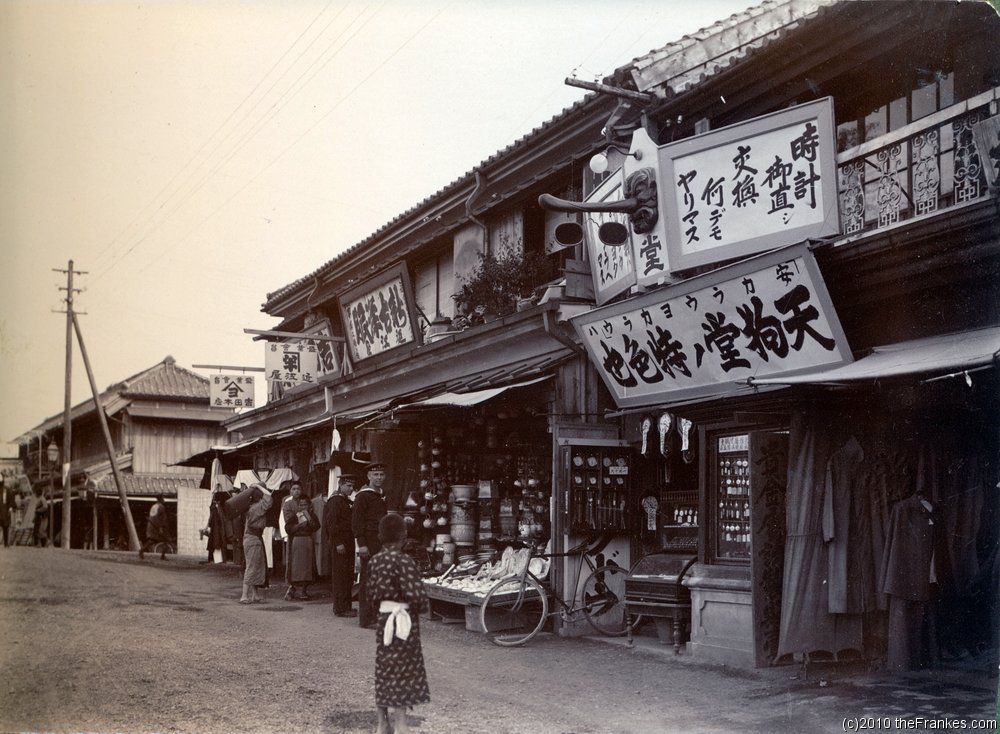
    Caption: "Strassenbild aus Iokohama" (Picture of a Yokohama street)

    In case you are interested, the complete set (work in progress) can be found here: http://www.thefrankes.com/wp/?page_id=1596

    Thanks!
    online at http://www.theFrankes.com
    while ( !( succeed = try() ) ) ;
    "Life is short, Art long, Occasion sudden and dangerous, Experience deceitful, and Judgment difficult." -Hippocrates
  • crokett
    The Full Monte
    • Jan 2003
    • 10627
    • Mebane, NC, USA.
    • Ryobi BT3000

    #2
    PM Hank Lee (leehljp). I believe he does.
    David

    The chief cause of failure in this life is giving up what you want most for what you want at the moment.

    Comment

    • cgallery
      Veteran Member
      • Sep 2004
      • 4503
      • Milwaukee, WI
      • BT3K

      #3
      The 2nd picture, the sign in the lower right-hand corner, says:

      "Head-on, Apply Directly to the Forehead."

      I also see a GoDaddy ad, and another for The Magic Bullet.

      Comment

      • Alex Franke
        Veteran Member
        • Feb 2007
        • 2641
        • Chapel Hill, NC
        • Ryobi BT3100

        #4
        Originally posted by cgallery
        The 2nd picture, the sign in the lower right-hand corner, says:

        "Head-on, Apply Directly to the Forehead."

        I also see a GoDaddy ad, and another for The Magic Bullet.
        ROFL! ...but where's the shot of Danica Patrick?
        online at http://www.theFrankes.com
        while ( !( succeed = try() ) ) ;
        "Life is short, Art long, Occasion sudden and dangerous, Experience deceitful, and Judgment difficult." -Hippocrates

        Comment

        • jussi
          Veteran Member
          • Jan 2007
          • 2162

          #5
          Originally posted by Alex Franke
          ROFL! ...but where's the shot of Danica Patrick?
          So Danica is over 100? Wow she ages nice!!
          I reject your reality and substitute my own.

          Comment

          • Uncle Cracker
            The Full Monte
            • May 2007
            • 7091
            • Sunshine State
            • BT3000

            #6
            Originally posted by jussi
            So Danica is over 100? Wow she ages nice!!
            She's just too spoiled and b!tchy to die...

            Comment

            • SARGE..g-47

              #7
              Besdes Hank.. Norm in Fujini does...

              Comment

              • herb fellows
                Veteran Member
                • Apr 2007
                • 1867
                • New York City
                • bt3100

                #8
                Pretty cool pictures!
                If you have no luck with the aforementioned:


                If all else fails, my SIL taught esl in Nagoya, Japan for 6 years, she's pretty good with it. Let me know if you need her.
                You don't need a parachute to skydive, you only need a parachute to skydive twice.

                Comment

                • leehljp
                  The Full Monte
                  • Dec 2002
                  • 8720
                  • Tunica, MS
                  • BT3000/3100

                  #9
                  This might take a while. If someone else wants to jump in - go ahead. I get a few minutes now and then for internet time. I can tell you that the kanji is OLD style as well as hand written. The hand written is not a problem. The old style kanji is very mis-directing.

                  Example is that the second picture, top sign on the right side; reading vertically right to left: the sign says Clock/watch repair; on the left side it says basically "we can do/fix anything". But the "anything" kanji is not one that has been used since I have been here in the 80's. It is an OLD kanji and not in use today except in nostalgic writings. It is not even in my dictionaries. I can tell what the character is by the context and slight shape similar to what is used today. Twenty years ago, one fellow spent several days with me showing me the transition of old characters into more simplistic characters used today. That one character is vaguely similar to todays but the context finishes the meaning.

                  ON the other signs, there is one character in most of them that throws everything for a loop for me to get it precise. I will work on this and see what I come up with. It will be a couple of days before I am with a Japanese to help me.

                  Don't expect that Japanese will automatically be able to read it either.

                  Last week we had a video team filming some of our team's work here. The videographer wanted a Japan sim card for his iPhone to use it here. The phone company needed an address, we didn't have the exact address of his hotel, so I gave my address (driver's license) to list with the sim card. The Japanese fellow asked me how to pronounce the kanji for my local address!

                  The videographer (American) had spent 4 years in Ch*na and was blown away because that Japanese fellow could not pronounce the kanji. Most kanji in Japanese (as opposed to Chinese) have several readings (pronunciations) and when it is names, the localization of the pronunciation or colloquialism is not known by outsiders of the immediate area. Somewhat like "Sean" - is that SEEN or SHAWN? By the way, the videographer knew what the characters meant, he just could not pronounce them and neither could the Japanese!


                  One more add-in. In the top picture you posted with the vertical signs, the sign on the left has a set of characters that often cause mispronunciation as much as any that I have come across. It has "city" kanji, "River" kanji and "city" kanji again. It is a name. The top "city" kanji is pronounced "ichi" and the bottom is pronounced "she". When you have two "city" kanji next to each other, one is ichi and the other is shi, very confusing sometimes.
                  Last edited by leehljp; 03-30-2010, 11:34 PM.
                  Hank Lee

                  Experience is what you get when you don't get what you wanted!

                  Comment

                  • phi1l
                    Senior Member
                    • Oct 2009
                    • 681
                    • Madison, WI

                    #10
                    Originally posted by leehljp
                    The Japanese fellow asked me how to pronounce the kanji for my local address!

                    I think it's the same everywhere, you would be surprised at how many people ask me how to pronounce Winnequah Trail.

                    Comment

                    • Uncle Cracker
                      The Full Monte
                      • May 2007
                      • 7091
                      • Sunshine State
                      • BT3000

                      #11
                      Originally posted by leehljp
                      Don't expect that Japanese will automatically be able to read it either.
                      Boy, is that ever the truth... I've sent brushings out to native Japanese speakers before, and had them fighting with one another over just whether to read right-to-left or left-to-right! And forget about what the writing actually said...

                      Comment

                      • leehljp
                        The Full Monte
                        • Dec 2002
                        • 8720
                        • Tunica, MS
                        • BT3000/3100

                        #12
                        Japanese text background explanation

                        When people ask me questions concerning culture or language, I have to say there usually is no "easy or simple" answer.

                        Japanese is one of the most complex languages in the world. Many people will name other languages and give reasons for it. However, our company has 5000 personnel in different countries around the world. Personnel in most countries learn the language in 1 year; 2 for some; we are the only country that is being pushed to get the 4 year norm down to 3 for college level comprehension.

                        Our language acquisition involves reading, writing as well as speaking and listening comprehension at this level.

                        WRITING KANJI:
                        EXAMPLE of difficulty. The Ch*nese character for "Day" looks like an "8" only the top and bottom are square instead of round. In Ch*nese it has only one pronunciation. In Japanese, it has at least 7 ways to pronounce it, depending upon where it is used in a sentence and which other character it is next to.
                        Some pronunciations: He (hi) be, ka, nichi, tachi, aki, nitsu.

                        WRITING ALPHABET: Japan has two alphabet systems - one for Japanese words (HIRAGANA) and one for foreign words (KATAKANA) - and it follows that pattern GENERALLY but not always. A long time ago, the alphabet for today's foreign words were used extensively for Japanese words; but that changed after WWII, or there abouts. Most Japanese write totally in the Hiragana and Kanji but use Katakana when writing to foreigners because many think all "foreigners" can read Katakana because Katakana is the language of foreigners!

                        LIMITED READING SKILLS: Japanese have nearly 50,000 kanji from the Ch*nese. However, Most Japanese learn only about 3000 or so in school and maybe 1000 more in specialty fields. IF a person is a banker or doctor, or lawyer, of course he/she will learn maybe 1000 more for their field.
                        The Point: Most Japanese cannot read the full gamut of characters that Ch*nese can. To be ignorant of many pronunciations - is an accepted standard here in Japan.

                        SPEAKING: There are several layers of speaking and communicating that are not just "dialects" that so many people like to categorize.

                        COMMUNICATING:
                        Direct and understandable communication is considered OK for close friends. But when this is used in business and at work, and you are not close friends with the manager, boss or co-worker, it is considered RUDE.

                        POLITENESS: is valued more than communication on the surface. The Polite form of language, in both written and spoken form (written and spoken forms are different) . . . is usually vague at best. But "good communication" that is direct and to the point - is RUDE and condescending. Catch 22!

                        Then there are the other two forms that are all their own and different: the family "in home" language. and the opposite or Keigo - extremely polite and respectful. This is used to speak to a high up official or president of a company or emperor etc. But if you use this to a coworker or someone near you in rank because you want to be respectful - it will usually be taken as rude and condescending!

                        3 writing systems;
                        4 levels of language and each are different;
                        Then there are the dialects that are not to be confused with the above.
                        Then there are the cultural differences between regions and cities!
                        Last edited by leehljp; 03-31-2010, 12:26 AM.
                        Hank Lee

                        Experience is what you get when you don't get what you wanted!

                        Comment

                        • Alex Franke
                          Veteran Member
                          • Feb 2007
                          • 2641
                          • Chapel Hill, NC
                          • Ryobi BT3100

                          #13
                          Originally posted by leehljp
                          Example is that the second picture, top sign on the right side; reading vertically right to left: the sign says Clock/watch repair; on the left side it says basically "we can do/fix anything". But the "anything" kanji is not one that has been used since I have been here in the 80's. It is an OLD kanji and not in use today except in nostalgic writings.
                          Hank, this is great stuff! Thanks so much for your help so far!

                          Now that you mention it, I do see a lot of clocks on display under that sign!
                          online at http://www.theFrankes.com
                          while ( !( succeed = try() ) ) ;
                          "Life is short, Art long, Occasion sudden and dangerous, Experience deceitful, and Judgment difficult." -Hippocrates

                          Comment

                          • leehljp
                            The Full Monte
                            • Dec 2002
                            • 8720
                            • Tunica, MS
                            • BT3000/3100

                            #14
                            Originally posted by Alex Franke

                            Click on the thumbnails for larger versions of the images...


                            Caption: "Japanische Singspielhalle" (Japanese music hall, or operahouse)
                            This is a kabuki theatre of long ago. Left vertical sign, middle sign in white letters and right side dark sign - all have the same basic writing which is the "Ichikawa family of Kabuki. Famous family even today!

                            The second and fourth sign are Matsumoto family; just as famous - then and now. So those signs outside of the Kabuki theater was like having a huge picture of John Wayne outside of a place that he would be appearing.

                            I do want to mention that the signs were photoed from the back side - i.e. the characters are viewed backwards in the photos!


                            Caption: "Strassenbild aus Iokohama" (Picture of a Yokohama street)
                            TOP SIGN: Clock and Watch Repair on the right side
                            Middle two characters is OLD Japanese but basically means "swap or exchange" (we think.)
                            The right side does mean we can do anything (referring to fixing or swapping).

                            The top and bottom sign of this picture represent very colloquial Japanese, something that is gone in most places.

                            BOTTOM SIGN:
                            (This is written from right to left in contrast to most of todays horizontal writing that goes from left to right. )
                            The spaced out writing on top says "Cheap and Good!"
                            Right side three characters Tengudou the name of that long nosed mask.
                            Left three characters: Tokusho nari - the name of the shop.


                            Hope this helps.

                            Hank
                            Last edited by leehljp; 04-01-2010, 10:00 AM.
                            Hank Lee

                            Experience is what you get when you don't get what you wanted!

                            Comment

                            • Alex Franke
                              Veteran Member
                              • Feb 2007
                              • 2641
                              • Chapel Hill, NC
                              • Ryobi BT3100

                              #15
                              Wow -- thanks a bundle. Do you mind if I add a comment with this information to the blog post where I have those photos? I'll of course attribute it to you, but I think my other readers would find this very interesting, too.

                              Originally posted by leehljp
                              I do want to mention that the signs were photoed from the back side - i.e. the characters are viewed backwards in the photos!
                              Is it possible that the photo itself is flipped horizontally? (e.g. the negative was upside down when the positive was made?)
                              online at http://www.theFrankes.com
                              while ( !( succeed = try() ) ) ;
                              "Life is short, Art long, Occasion sudden and dangerous, Experience deceitful, and Judgment difficult." -Hippocrates

                              Comment

                              Working...